

THE BREAKING POINT
Series Two — The Automation Economy
What Happens When the Math Stops Working
Part 1 of 8
America Built a Labor Model That Assumed Endless Growth
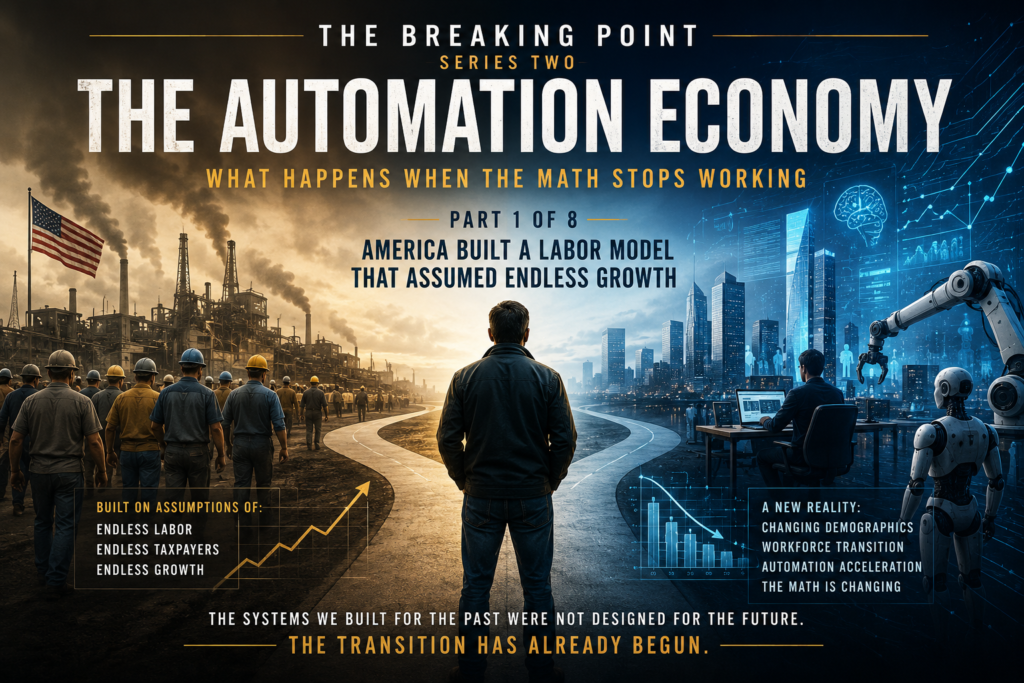
SERIES TWO INTRODUCTION
The Automation Economy
Series One of The Breaking Point focused on visible pressure building across America’s infrastructure systems. We explored overtime dependency, retirement obligations, burnout, labor shortages, and the quiet expansion of automation across industries already struggling to maintain stability.
But beneath all of those issues sits a larger question:
What happens when the economic assumptions America built around begin changing all at once?
Because many of the systems modern society depends on were designed during a period that looked very different from the world now emerging around us.
America Built a Labor Model That Assumed Endless Growth
For decades, much of the American economy operated on an assumption so deeply embedded that most people rarely questioned it.
Tomorrow would always be bigger than today.
There would always be more workers entering the system. More taxpayers supporting government programs. More consumers buying homes, cars, appliances, and services. More economic growth generating the momentum necessary to sustain expanding institutions.
That assumption shaped nearly everything.
It influenced retirement systems, healthcare structures, labor agreements, infrastructure planning, corporate growth expectations, public spending, and even the way Americans viewed success itself.
And for a very long time, the model largely worked.
America experienced industrial expansion, rising homeownership, growing middle-class participation, increasing productivity, and a workforce that continued expanding for generations.
Growth itself helped stabilize the system.
But the environment underneath many of those assumptions is beginning to change.
And that may be one of the most important economic transitions modern society has yet to fully confront.
The Model Worked Because the Workforce Kept Expanding
Many economic systems function best when large numbers of younger workers continually enter the labor force.
In those environments, retirement systems remain manageable because more active workers support fewer retirees. Tax revenue grows more naturally. Housing demand expands. Consumer spending increases. Infrastructure investment becomes easier to sustain.
Growth creates breathing room.
It allows governments, businesses, and institutions to absorb inefficiency longer because expansion itself helps offset pressure.
That became one of the foundational assumptions of the modern American labor model.
But assumptions built during periods of expansion can become vulnerable when growth begins slowing underneath them.
Demographics Quietly Change Everything
One of the least emotional but most powerful forces reshaping the economy today is demographics.
America is experiencing an aging population, lower birth rates, retirement waves, and slower workforce replacement across many industries.
These changes happen gradually enough that people often ignore them at first. There is no dramatic headline announcing demographic transition on a daily basis.
But over time, the pressure quietly spreads.
Retirement systems feel it. Healthcare systems feel it. Labor markets feel it. Public spending feels it. Staffing pipelines feel it.
Because many economic structures were designed around the expectation that younger generations would continuously grow large enough to support the systems built before them.
When those ratios begin shifting, the underlying math changes.
And unlike politics or social trends, demographic math does not respond emotionally. It simply compounds slowly over time.
The Workforce Itself Is Evolving
At the same time demographics are shifting, workforce expectations are changing as well.
Many younger workers increasingly prioritize flexibility, mobility, quality of life, autonomy, and work-life balance in ways previous generations often did not.
Technology has changed how people view work itself.
Remote work, digital entrepreneurship, scalable online income, content creation, and AI-assisted productivity are creating opportunities that did not exist for most of modern history.
Meanwhile, many traditional industries still depend heavily on older labor structures built around rigid schedules, physical presence, long-term tenure, and overtime-heavy operations.
That creates friction between systems designed for one era and workforce expectations emerging from another.
This does not automatically mean younger generations are less ambitious.
It may simply mean they are responding to a world where:
- housing costs are higher
- pensions are less common
- technology changes rapidly
- stability feels less guaranteed
- and work is no longer viewed the same way it once was
That distinction matters.
Technology Is Accelerating the Transition
Technology is not solely responsible for these economic shifts.
But it is accelerating them dramatically.
Artificial intelligence, automation, digital systems, and scalable software increasingly allow organizations to produce more output with fewer people.
Historically, economic growth depended heavily on expanding labor and physical infrastructure.
Today, value creation increasingly scales through:
- software
- algorithms
- intellectual property
- digital platforms
- automation
- AI-enhanced productivity
That changes how organizations think about labor itself.
Businesses no longer automatically assume growth requires proportional workforce expansion.
And that may become one of the defining economic shifts of the modern era.
The Old Assumptions Are Starting to Crack
Many institutions still operate as though the pressures appearing across society are temporary disruptions.
But similar patterns continue appearing across:
- healthcare
- education
- transportation
- manufacturing
- government
- logistics
- infrastructure
- housing
Labor shortages continue spreading. Burnout continues growing. Retirement pressure continues intensifying. Operational costs continue rising.
At the same time, technology continues improving rapidly.
The industries differ.
But the pressure patterns increasingly look connected.
That may not be coincidence.
It may signal that the underlying assumptions supporting many systems are beginning to change simultaneously.
This Is Not Necessarily Collapse
One of the biggest mistakes people make during periods of transition is assuming change automatically means collapse.
History suggests something different.
Major economic transitions often create instability, disruption, resistance, and uncertainty while new systems are still emerging.
The Industrial Revolution transformed agriculture, manufacturing, cities, labor, transportation, and family structures.
The digital revolution transformed communication, retail, media, entertainment, and information itself.
Artificial intelligence may represent another transition of similar scale.
The challenge is that institutions built during one economic era often struggle adapting quickly when the assumptions underneath them begin changing faster than expected.
The Real Issue Is Sustainability
The deeper question may not be whether growth stops entirely.
The deeper question may be:
What happens when systems designed around endless expansion collide with slower demographic growth, changing workforce expectations, and rapidly advancing technology?
Because many systems now face multiple pressures simultaneously.
An aging population. Shrinking workforce pipelines. Rising healthcare costs. Burnout. Operational complexity. Labor shortages. Automation incentives. Retirement obligations.
That combination changes the economic math underneath nearly everything.
AI Is Exposing the Transition Faster
Artificial intelligence may ultimately accelerate awareness more than anything else.
Because AI exposes inefficiency very quickly.
It exposes labor dependency, operational bottlenecks, scalability limitations, and outdated systems that previously survived simply because no better alternative existed.
Once technology creates a more scalable option, pressure begins intensifying rapidly.
Organizations start asking difficult questions.
Can fewer people produce more output?
Can systems operate more predictably?
Can technology offset labor shortages?
Can operations become less dependent on overtime and workforce instability?
Those questions are now appearing almost everywhere.
Final Thoughts
America did not build weak systems.
It built systems designed for a different era.
An era shaped by expanding labor participation, industrial growth, younger demographics, rising homeownership, and slower technological disruption.
But automation, demographic change, digital scalability, and evolving workforce expectations are beginning to reshape the assumptions underneath those systems.
That does not automatically mean collapse.
But it does mean transition.
And transitions often feel uncomfortable long before society fully understands what is changing underneath them.
The challenge now may not simply be preserving the systems of the past.
The challenge may be figuring out which parts of those systems can still scale in the future economy now beginning to emerge.
Coming Next in The Automation Economy
Part 2 of 8
The Taxpayer Ceiling Is Real
We’ll examine tax fatigue, government expansion, rising obligations, subsidy dependence, and why many Americans increasingly feel squeezed between growing costs and shrinking economic breathing room.
Hashtags:
#TheBreakingPoint #AutomationEconomy #ArtificialIntelligence #FutureOfWork #EconomicTransition #LaborMarket #Workforce #AI #EconomicReality #FutureEconomy #Technology #Demographics #WorkLifeBalance #Infrastructure #Leadership