

THE BURNING POINT
Infrastructure at the Breaking Point — Part 9 of 10
Burnout May Be America’s Biggest Labor Crisis
Previously in The Breaking Point
In Part 1, we explored how the Long Island Rail Road strike exposed growing operational pressure beneath America’s infrastructure systems.
In Part 2, we examined how overtime evolved into a permanent operational model across many industries.
In Part 3, we looked at retirement sustainability and shrinking worker-to-retiree ratios.
In Part 4, we explored how public systems can delay financial pressure longer than private companies.
In Part 5, we examined how Detroit became a warning sign for what happens when labor systems fail to adapt to changing economic realities.
In Part 6, we looked at how railroads have already spent decades quietly automating operations.
In Part 7, we explored the moment automation becomes more scalable and predictable than unstable labor systems.
In Part 8, we examined how seniority structures, overtime concentration, and workforce imbalance may unintentionally create new operational pressure.
Now we arrive at what may be the deepest issue underneath all of them:
Burnout.
Because burnout may not simply be a workplace problem anymore.
It may be becoming a national operational crisis.
Burnout May Be America’s Biggest Labor Crisis
America is exhausted.
Not just physically.
Mentally.
Emotionally.
Operationally.
Across nearly every major industry, workers increasingly describe the same feelings:
- fatigue
- emotional exhaustion
- cynicism
- anxiety
- disengagement
- constant pressure
And unlike temporary stress, burnout compounds over time.
It affects:
- judgment
- patience
- safety
- productivity
- health
- retention
- and eventually entire systems.
That is why burnout may quietly be becoming one of the most dangerous labor issues in America.
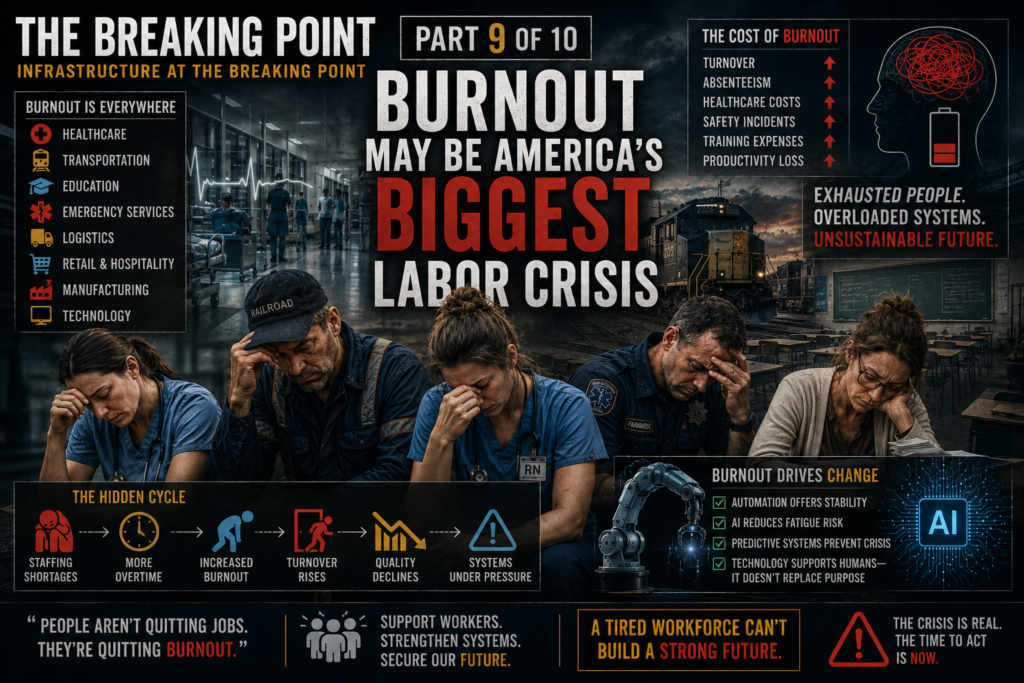
Burnout Is Showing Up Everywhere
The burnout problem is no longer isolated to one industry.
It now appears across:
- healthcare
- transportation
- education
- emergency services
- logistics
- retail
- hospitality
- manufacturing
- technology
Workers everywhere increasingly report:
- staffing shortages
- mandatory overtime
- emotional fatigue
- unpredictable scheduling
- unrealistic expectations
- constant operational pressure
And in many industries, there simply are not enough experienced workers available to relieve the pressure.
Healthcare May Be the Clearest Warning Sign
Few industries illustrate burnout more clearly than healthcare.
Doctors, nurses, technicians, and hospital staff increasingly face:
- long shifts
- staffing shortages
- emotional trauma
- administrative overload
- constant urgency
- rising patient demand
Many healthcare workers entered the profession because they genuinely wanted to help people.
But prolonged exhaustion can slowly erode even highly passionate workers.
The result is growing:
- turnover
- early retirement
- emotional detachment
- workforce instability
Which then places even more pressure on the workers who remain.
The cycle begins feeding itself.
Transportation Workers Face Similar Pressure
Transportation systems face many of the same dynamics.
Railroad employees, airline crews, truck drivers, dispatchers, and transit workers often deal with:
- overnight schedules
- fatigue
- overtime dependency
- public pressure
- safety responsibility
- staffing instability
In transportation, burnout creates more than emotional consequences.
It can create operational and safety risks.
That is one reason industries under fatigue pressure increasingly invest in:
- automation
- monitoring systems
- predictive scheduling
- AI-assisted operations
The goal is not always replacing workers.
Sometimes the goal is simply stabilizing exhausted systems.
Teachers Are Burning Out Too
Education increasingly faces similar challenges.
Teachers today often manage:
- overcrowded classrooms
- administrative demands
- behavioral issues
- emotional stress
- parent pressure
- technology adaptation
- declining engagement
Many educators entered teaching because they loved:
- learning
- mentorship
- helping students succeed
But burnout can slowly transform passion into exhaustion.
And when experienced teachers leave, schools often struggle to replace them with equally skilled educators.
That creates another dangerous cycle:
- burnout
- turnover
- staffing shortages
- reduced quality
- more pressure on remaining staff
Burnout Changes Workforce Behavior
One major shift happening across America is that workers increasingly prioritize:
- flexibility
- work-life balance
- emotional well-being
- schedule control
- reduced stress
Especially among younger generations.
Many employees no longer view:
- constant overtime
- endless availability
- burnout culture
- emotional exhaustion
…as acceptable long-term expectations.
That creates tension inside industries still built around older workforce models.
The Cost of Burnout Is Massive
Burnout is often discussed emotionally.
But economically, it creates enormous pressure.
Burnout contributes to:
- absenteeism
- turnover
- healthcare costs
- safety incidents
- training expenses
- reduced productivity
- operational instability
Organizations spend enormous resources trying to replace experienced workers who simply become exhausted.
And in industries already facing labor shortages, losing experienced employees becomes even more damaging.
Burnout Accelerates Automation
This may be one of the most important trends in the modern economy.
Burnout itself increasingly creates incentive for automation.
When organizations struggle with:
- fatigue
- turnover
- staffing instability
- overtime dependency
- emotional exhaustion
…technology begins looking more attractive operationally.
Automation offers:
- consistency
- predictability
- scalability
- reduced fatigue risk
- operational continuity
Again, this is not simply about eliminating workers.
It is often about stabilizing systems under extreme strain.
That distinction matters enormously.
AI Never Gets Emotionally Exhausted
Artificial intelligence changes the conversation because AI systems do not experience:
- burnout
- emotional fatigue
- mental exhaustion
- frustration
- disengagement
That does not make AI superior to humans.
Humans still dominate areas requiring:
- empathy
- leadership
- creativity
- emotional intelligence
- human connection
But for repetitive operational tasks, AI creates something increasingly valuable:
Stability.
And in exhausted systems, stability becomes incredibly attractive.
Burnout May Be Signaling Something Larger
The deeper issue may not simply be that workers are tired.
The deeper issue may be that many systems are operating beyond sustainable human capacity.
For years, industries often compensated for shortages through:
- overtime
- understaffing
- schedule compression
- emotional endurance
But eventually people hit limits.
And once enough workers begin reaching those limits simultaneously, entire systems start becoming unstable.
That may be one of the biggest labor realities America is now facing.
Final Thoughts
Burnout is not laziness.
And exhaustion is not weakness.
Many workers are carrying operational pressure levels that previous generations rarely experienced continuously.
The danger is that burnout often spreads quietly before systems recognize how severe it has become.
At first:
- morale drops
- turnover rises
- fatigue increases
Then eventually:
- staffing shortages worsen
- service quality declines
- safety risks increase
- automation accelerates
- operational instability spreads
Burnout may ultimately become one of the biggest accelerators of technological transformation in modern history.
Because once systems become too exhausted to sustain themselves…
organizations begin searching aggressively for anything capable of stabilizing the pressure.
And increasingly, that “something” is automation, AI, and digital operational systems.
Coming Next in The Breaking Point
Part 10 of 10
AI Didn’t Start This Crisis — It Revealed It
We’ll conclude the series by examining:
- how AI exposed deeper structural instability
- why automation may be a symptom instead of the root problem
- and what America’s labor, infrastructure, and operational future may look like moving forward.
Hashtags:
#TheBreakingPoint #Burnout #WorkforceBurnout #ArtificialIntelligence #FutureOfWork #LaborCrisis #Automation #EmployeeBurnout #OperationalEfficiency #StaffingShortages #EconomicReality #Workforce #MentalExhaustion #Infrastructure #AI