

THE BREAKING POINT
Infrastructure at the Breaking Point — Part 8 of 10
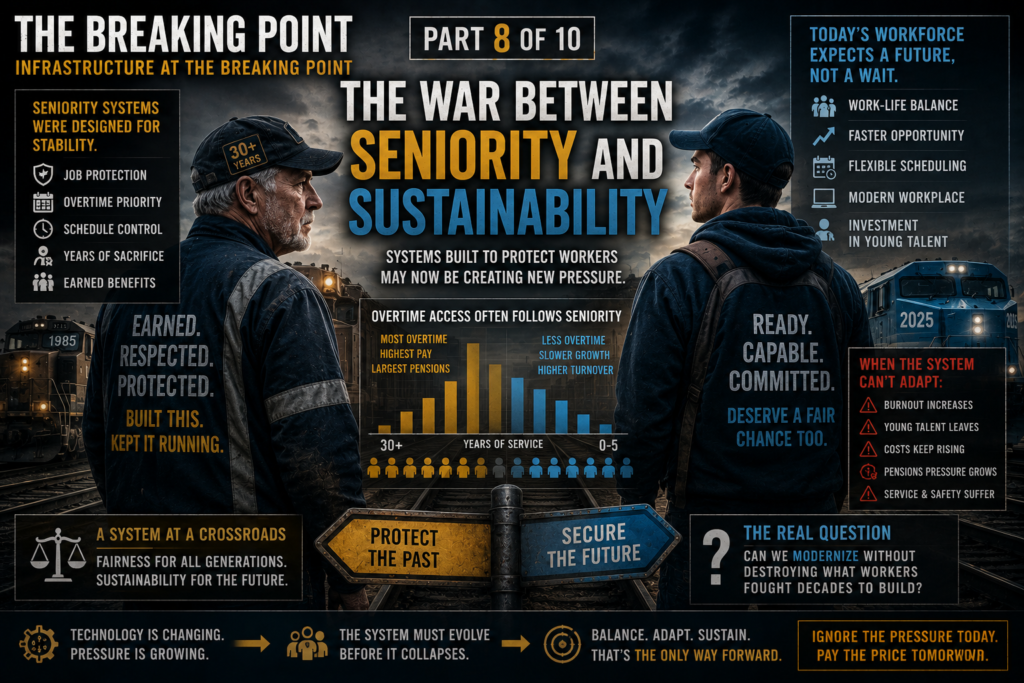
The War Between Seniority and Sustainability
Previously in The Breaking Point
In Part 1, we explored how the Long Island Rail Road strike revealed growing operational pressure beneath America’s infrastructure systems.
In Part 2, we examined how overtime evolved into a permanent operational model across many industries.
In Part 3, we looked at retirement sustainability and growing worker-to-retiree pressure.
In Part 4, we explored how public systems can delay financial pressure longer than private companies.
In Part 5, we looked at Detroit as an early warning sign of what happens when costs, competition, and automation collide faster than systems can adapt.
In Part 6, we examined how railroads have already spent decades quietly automating operations.
In Part 7, we explored the moment organizations begin viewing automation as more scalable and predictable than unstable labor systems.
Now we move into one of the most emotionally sensitive labor issues of all:
Seniority.
Because systems originally designed to protect workers may now be creating operational pressures few people want to discuss openly.
The War Between Seniority and Sustainability
For generations, seniority systems served an important purpose in American labor.
They helped protect workers from:
- favoritism
- political retaliation
- arbitrary discipline
- unstable scheduling
- management abuse
In many industries, seniority became the backbone of:
- overtime access
- vacation priority
- shift selection
- promotions
- job protection
And historically, many workers depended on those protections.
Especially in physically demanding industries where long-term loyalty mattered.
But systems designed during one economic era can create new pressure when operational realities begin changing.
That may be where many industries now find themselves.
Seniority Was Built on Stability
Most traditional labor systems were built around assumptions of:
- long careers
- predictable staffing
- stable workforces
- slower technological change
- gradual operational growth
In that environment, rewarding longevity made sense.
Workers sacrificed:
- nights
- holidays
- family time
- physical wear
- years of difficult labor
Seniority became a way to reward commitment and experience.
And in many ways, that structure helped create middle-class stability for millions of families.
Overtime Changed the Incentives
The problem becomes more complicated once overtime evolves from:
occasional extra work
into:
a permanent operating structure.
In many industries today, senior employees often gain first access to:
- premium shifts
- overtime opportunities
- preferred scheduling
That creates situations where:
- the highest-paid workers receive the most overtime
- pension calculations grow larger
- younger workers struggle to advance financially
- burnout becomes concentrated among experienced employees
The system may still follow the rules.
But operationally, the pressure begins building underneath the surface.
Younger Workers See the System Differently
Another major shift is generational.
Many younger workers increasingly value:
- flexibility
- work-life balance
- faster advancement
- schedule control
- quality of life
At the same time, many seniority systems still heavily reward:
- time served
- rigid hierarchy
- waiting years for opportunity
- overtime endurance
That disconnect creates frustration.
Especially in industries already struggling with recruitment and retention.
Some younger employees begin feeling:
“The system is designed for people who entered it decades ago.”
That perception can quietly damage workforce pipelines.
Burnout Often Concentrates at the Top
One of the hidden consequences of seniority-based overtime systems is that the most experienced workers often carry enormous operational burdens.
In many industries:
- senior employees know the systems best
- management relies on them heavily
- staffing shortages increase demand for their expertise
- overtime becomes financially difficult to refuse
Over time, some workers become trapped between:
- exhaustion
- financial incentive
- retirement planning
- operational pressure
That can accelerate:
- fatigue
- health problems
- emotional burnout
- early retirements
Ironically, the very workers the system depends on most may become the most overwhelmed.
Pension Structures Intensify the Pressure
In some industries, retirement systems calculate benefits using:
- highest earning years
- final compensation averages
- overtime-enhanced income
That creates additional incentive for employees near retirement to maximize overtime.
Again, this does not mean workers are doing anything wrong.
Most are simply operating within the structure that exists.
But structurally, it can create:
- rising pension obligations
- concentrated overtime
- labor imbalance
- operational instability
The pressure becomes systemic rather than personal.
Management Often Feels Handcuffed
Many managers privately struggle with balancing:
- operational efficiency
- labor agreements
- burnout prevention
- staffing fairness
- political pressure
- union negotiations
Some leadership teams feel unable to:
- redistribute overtime
- accelerate younger talent
- modernize scheduling
- adjust staffing models
…without triggering major labor conflict.
That creates another dangerous pattern:
Problems become easier to tolerate temporarily than solve permanently.
And delayed pressure often grows larger over time.
This Is Where Automation Becomes Attractive
When organizations experience:
- staffing imbalance
- overtime dependency
- burnout
- retirement waves
- rigid labor structures
- operational unpredictability
…the incentive to automate grows stronger.
Technology increasingly offers:
- consistency
- scalability
- predictability
- fatigue reduction
- scheduling stability
Again, automation is rarely driven by one issue alone.
It usually accelerates when multiple forms of operational pressure begin colliding simultaneously.
That is exactly what many industries are experiencing now.
The Emotional Divide Is Growing
This issue becomes emotionally difficult because both sides often feel justified.
Senior workers may feel:
“We earned these benefits through decades of sacrifice.”
Younger workers may feel:
“The system no longer gives us the same opportunity.”
Management may feel:
“The operational model is becoming unstable.”
Taxpayers and customers may feel:
“Costs keep rising while service struggles continue.”
All of those perspectives contain elements of truth.
That is what makes the problem so difficult politically and emotionally.
The Real Issue Is Adaptation
The deeper issue may not be whether seniority itself is wrong.
The real question is:
“Can labor systems designed decades ago still adapt effectively to modern operational pressure?”
Because today’s environment now includes:
- AI
- automation
- labor shortages
- demographic shifts
- burnout
- retirement pressure
- changing workforce expectations
- operational complexity
That creates pressure many older systems were never originally designed to handle.
Final Thoughts
Seniority systems helped build stability for generations of American workers.
That history deserves respect.
But systems built for one era sometimes struggle when economic realities fundamentally change.
The goal should not be:
- attacking workers
- demonizing unions
- or eliminating protections
The real challenge is figuring out how to balance:
- fairness
- sustainability
- operational stability
- workforce development
- and long-term scalability
Because once systems become too rigid to adapt…
pressure eventually builds somewhere else.
And increasingly, that pressure is pushing organizations toward technology, automation, and operational restructuring.
The question may no longer be whether change is coming.
The real question is whether systems can evolve before the pressure forces change for them.
Coming Next in The Breaking Point
Part 9 of 10
Burnout May Be America’s Biggest Labor Crisis
We’ll examine:
- emotional exhaustion
- workforce fatigue
- healthcare burnout
- transportation fatigue
- staffing collapse
- mental strain
- and why burnout itself may become one of the biggest accelerators of automation in modern history.
Hashtags:
#TheBreakingPoint #SenioritySystems #Burnout #Labor #Overtime #FutureOfWork #ArtificialIntelligence #Automation #Workforce #Infrastructure #EconomicReality #OperationalEfficiency #PensionPressure #Leadership #LaborShortages