

THE BREAKING POINT
Infrastructure at the Breaking Point — Part 10 of 10
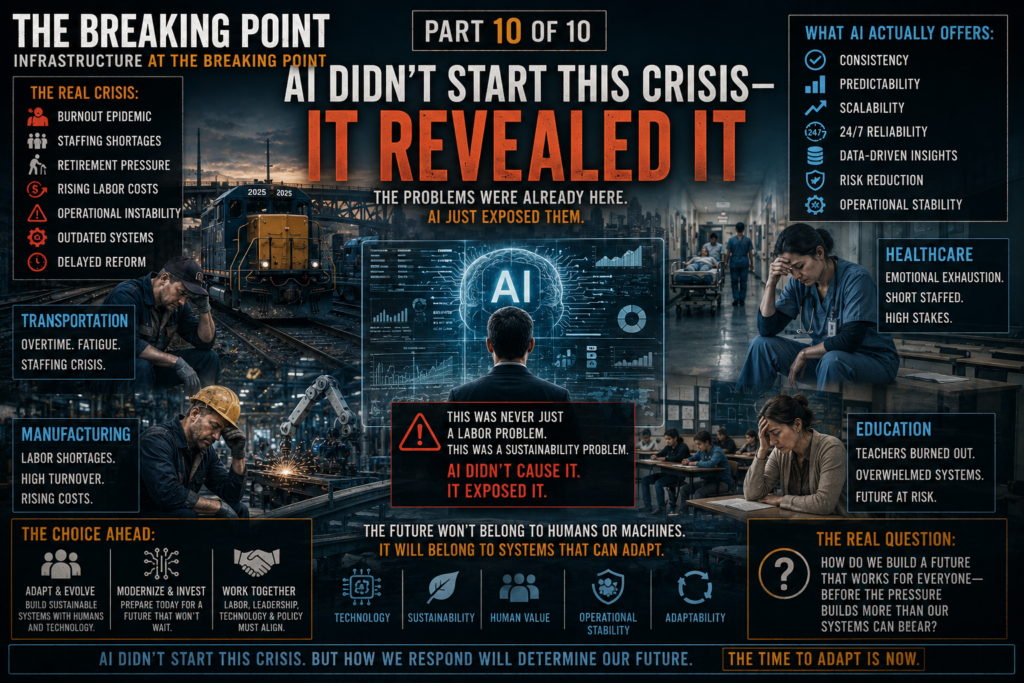
AI Didn’t Start This Crisis — It Revealed It
Previously in The Breaking Point
In Part 1, we explored how the Long Island Rail Road strike revealed growing pressure beneath America’s infrastructure systems.
In Part 2, we examined how overtime quietly evolved into a permanent operational model across many industries.
In Part 3, we looked at retirement sustainability and shrinking worker-to-retiree pressure.
In Part 4, we explored how public systems can delay financial pressure longer than private companies.
In Part 5, we examined how Detroit became a warning sign for what happens when labor systems fail to adapt to changing economic realities.
In Part 6, we explored how railroads have already spent decades quietly automating operations.
In Part 7, we looked at the tipping point where automation becomes more scalable and predictable than unstable labor systems.
In Part 8, we examined how seniority structures and overtime concentration may unintentionally create new operational pressure.
In Part 9, we explored how burnout may quietly be becoming America’s biggest labor crisis.
Now we arrive at the final and perhaps most important realization of all:
Artificial intelligence did not create these pressures.
It exposed them.
AI Didn’t Start This Crisis — It Revealed It
Many people talk about artificial intelligence as if it suddenly appeared and disrupted a stable world.
But the truth may be far more uncomfortable.
The pressure was already building long before AI became mainstream.
America was already facing:
- burnout
- staffing shortages
- rising labor costs
- retirement pressure
- operational instability
- shrinking workforce participation
- infrastructure strain
- productivity challenges
Artificial intelligence did not create those problems.
It simply arrived at the exact moment many systems were already struggling to sustain themselves.
The Pressure Was Building for Decades
Much of America’s operational infrastructure was built during very different economic conditions.
Many systems were designed during periods of:
- population growth
- expanding labor participation
- lower life expectancy
- different retirement structures
- slower technological change
- less operational complexity
For years, organizations compensated through:
- overtime
- workforce expansion
- debt
- taxpayer support
- emotional endurance
- delaying structural reform
But eventually the pressure started compounding faster than the systems could adapt.
That is where many industries now find themselves.
AI Arrived During Maximum Instability
Artificial intelligence is accelerating precisely because systems are already under strain.
Organizations everywhere increasingly face:
- labor shortages
- exhausted workers
- retirement waves
- rising healthcare costs
- staffing unpredictability
- operational fatigue
- growing complexity
In that environment, AI begins looking less like futuristic innovation…
and more like operational stabilization.
That distinction changes everything.
AI Offers What Exhausted Systems Need Most
One reason AI adoption is accelerating so quickly is because AI offers something many strained systems desperately need:
Consistency.
AI systems do not:
- burn out
- retire
- require overtime
- call in sick
- become emotionally exhausted
- struggle with staffing shortages
Again, that does not mean humans lose value.
Human beings still dominate:
- creativity
- empathy
- leadership
- judgment
- emotional intelligence
- adaptability
But operational systems increasingly prioritize:
- predictability
- scalability
- stability
- continuous performance
And those priorities naturally increase technology investment.
The Real Crisis Was Sustainability
The deeper issue may never have been labor itself.
The deeper issue was sustainability.
Many systems increasingly became dependent on:
- overtime
- aging workers
- burnout endurance
- debt expansion
- shrinking workforce pipelines
- delayed reform
That created fragile operational structures.
For years, those pressures remained partially hidden because people kept pushing through.
But eventually:
- exhaustion spreads
- turnover rises
- recruitment weakens
- operational instability grows
AI simply exposed how dependent many systems had become on unsustainable human strain.
Burnout Changed the Equation
One of the biggest accelerators of AI adoption may ultimately be burnout itself.
When organizations experience:
- emotional exhaustion
- staffing instability
- retention collapse
- overtime dependency
- operational fatigue
…technology begins looking increasingly attractive.
Not because businesses hate workers.
But because exhausted systems become difficult to sustain.
That may be one of the most misunderstood aspects of modern automation.
Often the pressure itself creates the incentive.
The Future Workforce Will Look Different
The future labor force may not disappear.
But it will likely evolve dramatically.
Many repetitive operational tasks may increasingly become:
- automated
- AI-assisted
- digitally monitored
- algorithmically optimized
At the same time, human value may increasingly concentrate around:
- creativity
- leadership
- relationship building
- emotional intelligence
- strategic thinking
- adaptability
That transition may become one of the biggest workforce shifts since the Industrial Revolution.
The Emotional Reaction Is Understandable
People naturally fear disruption.
Especially when:
- livelihoods
- identities
- communities
- and entire industries
feel threatened.
That fear is understandable.
Because technological transitions historically create:
- uncertainty
- displacement
- instability
- emotional resistance
But ignoring the underlying pressure does not stop transformation from occurring.
History repeatedly shows that once:
- economics
- operational pressure
- and technological capability
…align together, industries eventually change.
This Is Bigger Than Railroads
What started as a conversation about railroads now clearly stretches far beyond transportation.
The same pressure patterns increasingly appear across:
- healthcare
- education
- logistics
- manufacturing
- public infrastructure
- customer service
- retail
- finance
The industries differ.
But the operational pressures often look remarkably similar.
That may be the real story artificial intelligence is exposing.
AI Is Not the Villain
One of the biggest mistakes society may make is treating AI itself as the root problem.
Technology did not create:
- burnout
- unsustainable overtime
- labor shortages
- demographic pressure
- pension strain
- operational inefficiency
Those pressures were already building.
AI simply arrived during a moment when systems had become increasingly vulnerable.
That is why the conversation should not simply focus on:
“How do we stop AI?”
The deeper question may be:
“Why were our systems already struggling before AI accelerated?”
That is a much harder conversation.
Final Thoughts
Artificial intelligence did not start America’s labor crisis.
It revealed it.
It revealed:
- exhausted systems
- strained workforces
- unsustainable structures
- delayed reform
- operational fragility
- and economic pressure that had been building quietly for decades
The future may not belong entirely to humans or machines.
More likely, it will belong to the systems capable of balancing:
- technology
- sustainability
- human value
- operational stability
- and adaptability
That may ultimately become the real challenge of the modern economy.
Because the biggest threat may not be artificial intelligence itself.
The biggest threat may be systems that waited too long to adapt while the pressure kept building underneath them.
End of Series One
Infrastructure at the Breaking Point
Next in The Breaking Point:
Series Two
The Automation Economy
What Happens When the Math Stops Working
We’ll expand the conversation into:
- taxes
- ownership
- financial literacy
- dependency systems
- scalable work
- AI economics
- and the future structure of the American economy itself.
Hashtags:
#TheBreakingPoint #ArtificialIntelligence #AI #FutureOfWork #Automation #LaborCrisis #Burnout #OperationalEfficiency #Infrastructure #EconomicReality #Workforce #Technology #AIandLabor #FutureEconomy #Leadership