

THE BREAKING POINT
Series Two — The Automation Economy
What Happens When the Math Stops Working
Part 2 of 8
The Taxpayer Ceiling Is Real
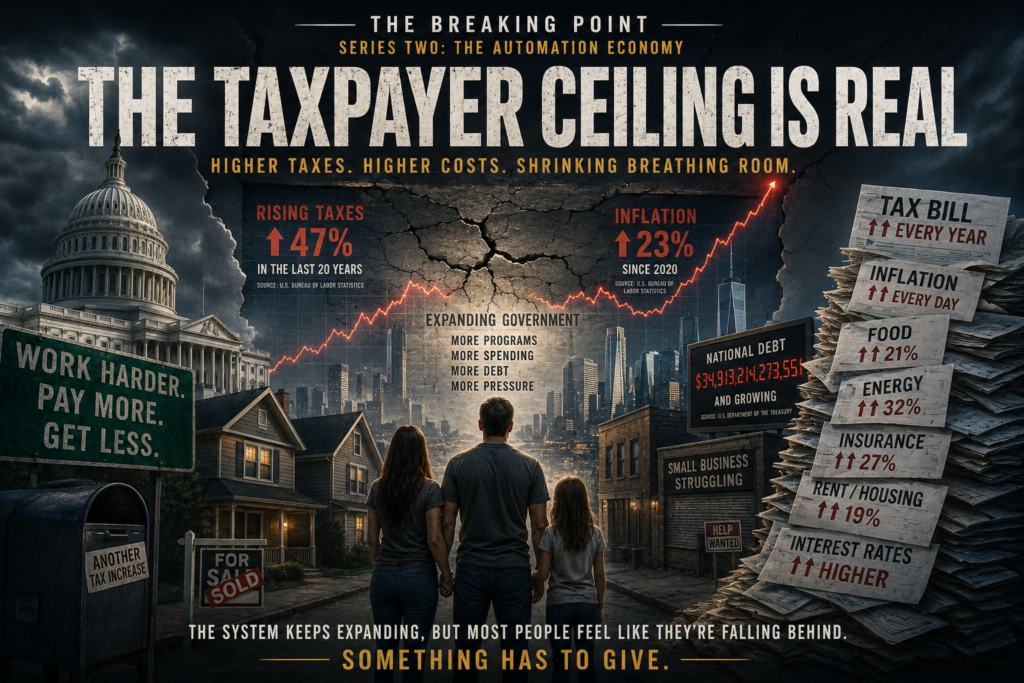
The Taxpayer Ceiling Is Real
One of the least discussed realities in modern economics is that every system eventually reaches pressure limits.
Businesses do.
Families do.
Governments do.
And taxpayers do too.
For decades, America operated under an assumption that economic growth would continue creating enough expansion to absorb rising obligations over time. More workers would enter the economy. More taxpayers would support government systems. Productivity would rise. Home values would climb. Consumer spending would expand.
Growth itself created breathing room.
As long as tomorrow kept getting larger than today, systems could continue expanding without forcing society to confront the long-term math underneath them.
But something has started changing.
Across the country, many Americans increasingly feel like they are running harder financially while gaining less stability in return. And whether people realize it or not, that growing pressure may become one of the defining economic realities of the next generation.
Most Americans Are Not Anti-Tax
One important point often gets lost in political arguments.
Most Americans understand the need for functioning systems. Roads have to be maintained. Schools need funding. Infrastructure requires investment. Police, fire departments, healthcare systems, and national defense all cost money.
The issue is usually not whether government should exist.
The issue becomes whether people still believe the systems they are funding feel sustainable, efficient, and fair.
That distinction matters enormously.
Because taxpayers tend to tolerate pressure much longer when they believe:
- the systems are functioning properly
- sacrifice feels shared
- leadership appears competent
- and the future still feels attainable
But once people begin feeling squeezed from every direction simultaneously, frustration starts building quickly.
The Pressure Rarely Comes From One Thing
For many middle-class Americans, the pressure no longer feels isolated.
It feels cumulative.
A little more for groceries.
A little more for insurance.
A little more for utilities.
A little more for healthcare.
A little more for housing.
A little more for property taxes.
Over time, those increases change how people experience daily life psychologically. Even workers receiving raises often discover those raises no longer create the same sense of progress they once did.
Because when the cost of simply maintaining stability rises faster than financial breathing room, people begin feeling trapped even while technically earning more money.
That emotional pressure matters far more than many economists acknowledge.
Government Obligations Continue Expanding
At the same time households feel pressure growing at home, government systems are also becoming more expensive to maintain.
Healthcare costs continue rising. Infrastructure continues aging. Retirement obligations continue expanding. Debt servicing grows larger. Public programs become increasingly difficult to reduce because millions of people genuinely depend on them.
That creates a difficult balancing act.
The same taxpayers feeling financial strain are also the ones funding increasingly expensive systems at the local, state, and federal levels.
Eventually society begins approaching a difficult question:
How much pressure can the average taxpayer realistically absorb before resistance begins growing?
That question is becoming harder to avoid.
Inflation Quietly Changes Human Behavior
Inflation rarely feels dramatic all at once.
Instead, it slowly erodes confidence over time.
People start delaying purchases. Families postpone vacations. Younger generations question whether homeownership still feels realistic. Retirees become more cautious. Workers begin reevaluating career paths and quality-of-life priorities.
Even successful households increasingly describe feeling financially stretched despite objectively earning decent incomes.
That is one reason modern economic pressure feels so emotionally exhausting.
People are not simply responding to numbers.
They are responding to uncertainty.
The Old Economic Model Relied Heavily on Expansion
Much of modern government finance quietly depends on growth.
Growth in population.
Growth in labor participation.
Growth in tax revenue.
Growth in housing values.
Growth in consumer spending.
Expansion creates room for systems to absorb inefficiency longer because rising economic activity helps stabilize the pressure underneath them.
But when demographic growth slows, workforce participation changes, debt expands, and costs rise faster than productivity gains, the underlying math becomes harder to sustain indefinitely.
That does not automatically mean collapse.
But it does mean the margin for error becomes smaller.
Artificial Intelligence Complicates the Equation
Artificial intelligence introduces another major layer into this transition.
Historically, large labor forces helped support:
- payroll taxes
- income taxes
- retirement systems
- consumer spending
- healthcare funding
But what happens if future productivity increasingly scales through automation, software, and AI-enhanced systems instead of continually expanding human labor?
That question may eventually force governments to rethink taxation itself.
Because economic systems designed around industrial-era labor models may struggle adapting to economies where technology produces increasing amounts of value with fewer traditional workers involved.
That transition could become one of the defining policy debates of the next several decades.
Beneath the Economics Is a Fear of Instability
Underneath many modern economic conversations sits a deeper emotional concern.
People fear losing stability.
Not necessarily wealth.
Stability.
The ability to own a home. Raise children comfortably. Retire someday. Absorb emergencies without collapse. Believe that hard work still leads somewhere meaningful long term.
When enough people begin doubting whether those things remain realistically achievable, economic pressure becomes emotional pressure.
And emotional pressure eventually becomes political pressure.
That pattern has repeated throughout history during major periods of transition.
This Is Bigger Than Politics
One mistake people make is viewing taxpayer fatigue as purely partisan.
Often it is operational.
People increasingly sense that:
- systems feel more expensive
- life feels less predictable
- institutions feel strained
- and future stability feels less certain
At the same time, technology continues advancing rapidly while traditional economic structures struggle adapting to the pace of change.
That combination creates a strange environment where society simultaneously experiences:
- incredible technological progress
and - growing emotional and financial insecurity
That contradiction may become one of the defining characteristics of the modern economy.
Final Thoughts
The taxpayer ceiling is not a precise number.
It is a pressure threshold.
The point where enough people begin feeling financially stretched, emotionally fatigued, and uncertain whether the systems surrounding them still feel sustainable long term.
America remains one of the most productive and innovative economies in the world.
But innovation alone does not eliminate structural pressure.
And growth alone may no longer solve problems automatically the way it once did.
That may be one of the most important transitions now unfolding underneath the modern economy.
Because the future challenge may not simply involve generating more economic activity.
It may involve figuring out how to maintain stability, opportunity, and sustainability while the underlying math of labor, technology, demographics, and growth itself continues changing all at once.
Coming Next in The Automation Economy
Part 3 of 8
Are We Raising Builders or Consumers?
We’ll examine financial literacy, social media culture, ownership versus dependency, scalable income, and whether younger generations are being prepared to build long-term wealth… or simply consume the systems surrounding them.
Hashtags:
#TheBreakingPoint #AutomationEconomy #TaxpayerFatigue #EconomicPressure #ArtificialIntelligence #FutureEconomy #Inflation #MiddleClass #EconomicReality #GovernmentSpending #Workforce #AI #Leadership #FinancialPressure #FutureOfWork