

THE BREAKING POINT
Series Two — The Automation Economy
What Happens When the Math Stops Working
Part 6 of 8
Universal Basic Income Stops Sounding Crazy When the Math Changes
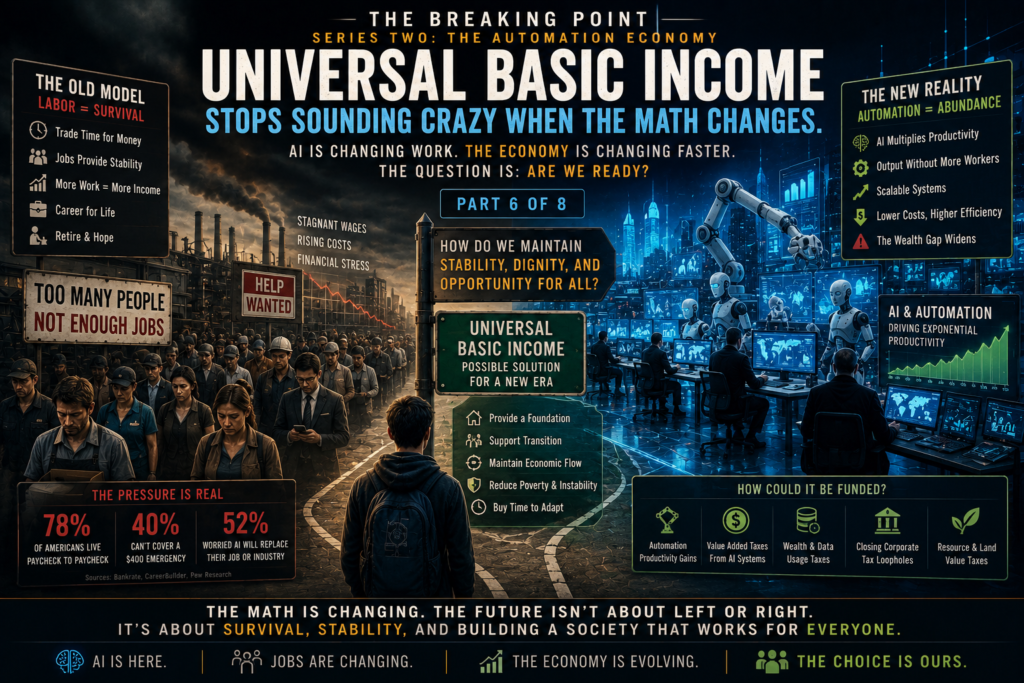
Universal Basic Income Stops Sounding Crazy When the Math Changes
Not long ago, the idea of Universal Basic Income sounded politically impossible to many Americans.
The concept was often dismissed as:
- unrealistic
- unaffordable
- anti-work
- or economically dangerous
But something interesting has started happening.
As artificial intelligence, automation, and scalable technology continue accelerating, conversations once considered fringe are increasingly entering mainstream economic discussion.
Not necessarily because society suddenly became more ideological.
But because the math underneath the economy may be changing faster than many systems were originally designed to handle.
And once the underlying math changes, ideas that once sounded absurd sometimes start sounding inevitable to certain groups of people.
Every Economy Depends on Participation
Modern economies function best when large numbers of people actively participate through:
- work
- consumption
- investment
- taxation
- ownership
- and economic mobility
That participation creates circulation.
Workers earn income.
Income supports spending.
Spending supports businesses.
Businesses hire workers.
Tax revenue funds systems.
For decades, industrial-era economies relied heavily on expanding labor participation to keep that cycle functioning smoothly.
But artificial intelligence may gradually begin disrupting the relationship between labor and productivity itself.
That is where the conversation becomes complicated.
AI Could Increase Productivity Without Expanding Employment
Historically, economic growth often required larger workforces.
If production increased, businesses usually hired more people.
If companies expanded, employment expanded alongside them.
But AI changes that equation.
Increasingly, organizations may be capable of:
- producing more output
- serving larger markets
- automating operations
- reducing overhead
- scaling digitally
without proportionally increasing human labor.
That does not mean all jobs disappear.
But it does mean the historical relationship between productivity growth and workforce expansion may begin weakening.
And that possibility forces difficult economic questions.
The Debate Is Really About Stability
Most conversations around Universal Basic Income quickly become political.
But underneath the politics sits a more fundamental concern:
What happens if large portions of society begin struggling to maintain stable economic participation in a highly automated world?
Because societies require more than productivity alone.
They also require:
- purchasing power
- social stability
- economic mobility
- and some level of broad participation
If technology dramatically increases productivity while simultaneously reducing the scalability of traditional labor, pressure naturally builds around how economic systems continue functioning long term.
That is the real conversation many economists are increasingly exploring.
The Fear Is Not Just Job Loss
One important misunderstanding is the idea that automation fears are only about unemployment.
The deeper fear may involve disconnection.
People want more than income.
They want:
- purpose
- contribution
- identity
- independence
- upward mobility
- and the feeling that they still matter inside the economy
Historically, work provided much of that structure.
If automation weakens traditional labor participation significantly over time, societies may eventually face psychological and cultural questions far larger than economics alone.
That is why this debate becomes emotionally complicated very quickly.
Technology Historically Creates New Jobs — But AI Feels Different
One common argument is that every technological revolution eventually created new forms of employment.
And historically, that is true.
The Industrial Revolution displaced many forms of labor while creating entirely new industries.
The internet eliminated some jobs while creating countless others.
But artificial intelligence feels different to many people because it increasingly impacts:
- physical labor
- administrative work
- analysis
- logistics
- customer service
- content generation
- and even portions of creative work simultaneously
In other words, AI is not just automating muscle.
It is beginning to automate portions of cognition itself.
That creates uncertainty people have never fully experienced at this scale before.
Universal Basic Income Is Really About Buying Time
One reason UBI conversations are growing is because some economists believe societies may eventually need mechanisms that create stability during periods of rapid technological transition.
Not necessarily forever.
But long enough for economies and labor markets to adapt.
In that context, Universal Basic Income becomes less about “free money” and more about:
- social stabilization
- economic transition management
- consumption continuity
- and preventing large-scale disruption during automation acceleration
Whether people agree with the idea or not, the conversation itself reveals how seriously some experts view the possibility of major workforce disruption over time.
The Real Danger May Be Dependency Without Ownership
One major concern critics raise involves dependency.
If people become increasingly disconnected from ownership, production, and meaningful economic participation, societies may drift toward systems where large portions of the population depend heavily on centralized support structures.
That creates difficult long-term questions about:
- motivation
- innovation
- personal responsibility
- freedom
- and economic independence
Because healthy societies generally require more than survival.
They require opportunity.
That is why many people believe the better long-term solution may involve helping individuals:
- build ownership
- adapt skills
- leverage technology
- create scalable value
- and participate in the future economy more effectively
rather than simply relying on permanent support systems.
The Bigger Question Is What Society Values
At its core, this debate eventually becomes philosophical.
If artificial intelligence dramatically increases productivity, societies may eventually need to decide:
- how value gets distributed
- how work gets defined
- what contribution means
- and how people maintain dignity and purpose in increasingly automated environments
Those are not purely economic questions.
They are human questions.
And historically, societies often struggle emotionally during periods where old definitions of work and value begin changing rapidly.
This Conversation Is Coming Faster Than Many Expect
One reason these debates feel uncomfortable is because technological transitions often seem gradual…
until suddenly they are everywhere.
A few years ago, many people viewed AI as distant experimentation.
Today it already influences:
- business operations
- media
- education
- customer service
- software development
- healthcare
- logistics
- marketing
- and creative industries
The pace of change itself may become one of the biggest drivers of public anxiety.
Because institutions often adapt far slower than technology evolves.
Final Thoughts
Universal Basic Income may or may not ultimately become part of the future economy.
But the fact that serious people increasingly discuss it reveals something important:
Many experts believe automation, artificial intelligence, and scalable digital systems could eventually reshape labor markets more dramatically than previous technological revolutions did.
The deeper issue is not whether people deserve support.
The deeper issue is how societies maintain:
- stability
- purpose
- mobility
- opportunity
- and human dignity
during periods of rapid technological transition.
Because once the economic math underneath labor begins changing, conversations that once sounded impossible can suddenly start sounding practical to people trying to preserve stability inside systems under pressure.
And whether society embraces those ideas or rejects them, the debate itself may become one of the defining conversations of the AI era.
Coming Next in The Automation Economy
Part 7 of 8
The Future Economy May Reward Creativity More Than Labor Hours
We’ll examine how artificial intelligence may shift economic value toward creativity, adaptability, intellectual leverage, and scalable human contribution instead of purely time-based labor.
Hashtags:
#TheBreakingPoint #UniversalBasicIncome #ArtificialIntelligence #AutomationEconomy #FutureOfWork #AI #EconomicTransition #FutureEconomy #Technology #Workforce #Innovation #EconomicReality #DigitalEconomy #Leadership #Automation