

THE BREAKING POINT
Series Two — The Automation Economy
What Happens When the Math Stops Working
Part 5 of 8
When Labor Stops Scaling, AI Starts Winning
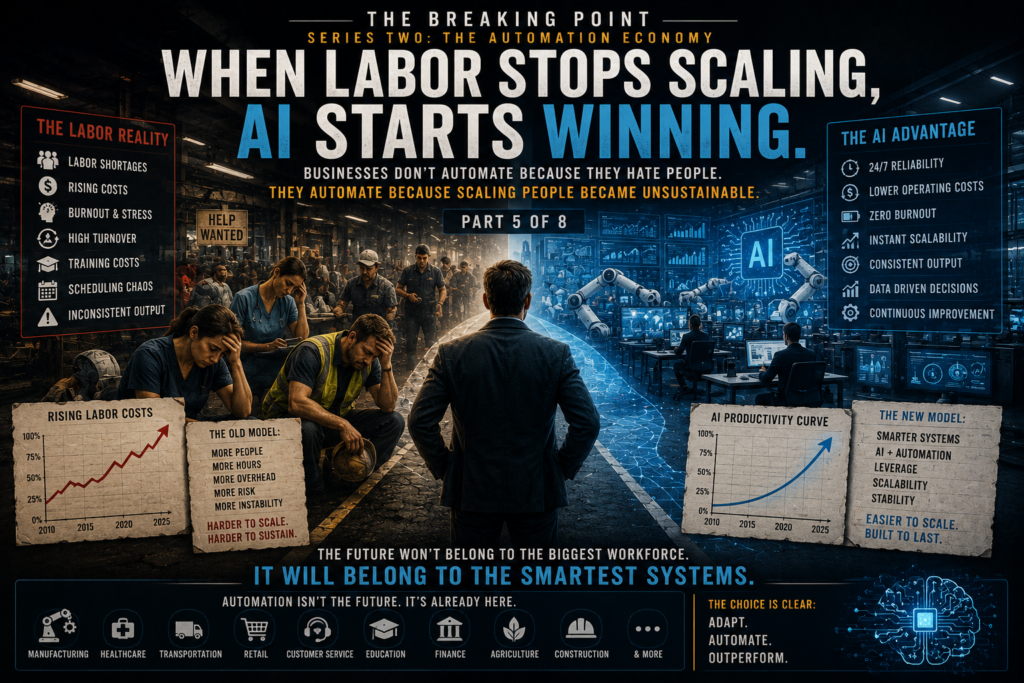
When Labor Stops Scaling, AI Starts Winning
For most of modern history, labor was the engine that powered growth.
If businesses wanted to expand, they hired more people.
If demand increased, companies scaled through larger workforces, bigger facilities, more managers, and expanded operational systems.
That model built much of the modern economy.
But something important is beginning to change underneath it.
In industry after industry, organizations are discovering that labor itself is becoming harder to scale predictably.
Not because people suddenly stopped mattering.
And not because businesses no longer value human workers.
But because the operational environment surrounding labor has become increasingly unstable, expensive, and difficult to sustain at scale.
That shift may become one of the biggest accelerators of artificial intelligence adoption in the modern economy.
The Problem Is Not Simply Wages
One of the biggest misunderstandings in the automation debate is the idea that companies only automate to avoid paying workers more money.
The reality is usually far more complicated.
Labor costs absolutely matter.
But businesses are also dealing with:
- staffing shortages
- turnover
- burnout
- training costs
- scheduling instability
- healthcare expenses
- retirement obligations
- operational unpredictability
Over time, the pressure compounds.
And eventually leadership teams stop asking:
“Can we grow?”
They start asking:
“Can this system continue scaling reliably at all?”
That is a very different question.
Burnout Changes Operational Stability
One of the biggest hidden drivers behind automation may actually be workforce exhaustion.
Many industries now operate under constant pressure.
Healthcare systems struggle finding enough experienced staff. Transportation industries rely heavily on overtime. Retail and hospitality continue facing turnover instability. Schools struggle with retention and staffing consistency.
In many environments, organizations are no longer simply managing labor.
They are managing fatigue.
That changes how leadership evaluates technology.
Because once systems begin operating in survival mode long enough, stability itself becomes extremely valuable.
And artificial intelligence offers something businesses increasingly prioritize:
predictability.
AI Does Not Experience Human Limits
Artificial intelligence systems do not:
- burn out
- call in sick
- retire
- require overtime
- emotionally disengage
- struggle with scheduling
That does not make AI superior to humans.
Human beings still dominate areas requiring:
- creativity
- empathy
- leadership
- emotional intelligence
- adaptability
- judgment
But operational systems increasingly prioritize consistency and scalability alongside human skill.
And in environments under constant staffing pressure, scalable systems become extremely attractive.
Especially when organizations feel trapped between:
- rising costs
- unstable labor pipelines
- and growing operational complexity
The Economy Is Quietly Rewarding Stability
One of the deeper shifts happening underneath the modern economy is that stability itself is becoming a premium asset.
Businesses increasingly value systems capable of:
- predictable output
- continuous operation
- scalable productivity
- lower operational volatility
Historically, labor systems often provided that stability.
But in many industries today, staffing unpredictability has become one of the largest operational risks organizations face.
That changes how businesses think about investment.
Automation no longer feels like futuristic experimentation.
Increasingly, it feels like operational protection.
This Is Happening Across Nearly Every Industry
The transition is no longer isolated to manufacturing.
Healthcare increasingly uses AI-assisted diagnostics and automation systems.
Transportation industries rely more heavily on predictive technology and digital monitoring.
Customer service operations continue moving toward AI-driven support systems.
Retail increasingly automates inventory management, checkout systems, logistics, and forecasting.
Even education is beginning to explore AI-assisted instruction and scalable digital learning environments.
Different industries are moving at different speeds.
But the direction increasingly looks similar.
Organizations everywhere are asking:
“What functions can technology stabilize more reliably?”
The Traditional Labor Model Assumed Endless Human Scalability
For decades, many systems quietly assumed there would always be:
- enough workers
- enough overtime
- enough replacement labor
- enough taxpayers
- enough institutional endurance
But demographic changes, workforce expectations, burnout, and operational pressure are now challenging many of those assumptions simultaneously.
That is why labor instability now appears across industries that once seemed extremely stable.
And once scalability begins weakening inside labor systems, technology adoption accelerates naturally.
Because organizations eventually seek whatever solutions appear capable of restoring predictability.
This Is Not Necessarily Anti-Worker
One important distinction matters enormously.
Most businesses do not wake up every morning asking:
“How do we eliminate humans?”
Most organizations simply want systems capable of functioning consistently.
The challenge is that labor instability creates pressure businesses often cannot fully control.
When staffing shortages continue, overtime rises, burnout spreads, and operational costs escalate, technology increasingly becomes viewed as a stabilizing force rather than simply a cost-cutting tool.
That is why the automation conversation is often less emotional inside boardrooms than it appears publicly.
Leadership teams frequently view automation through the lens of:
- operational continuity
- scalability
- risk management
- and long-term sustainability
Not ideology.
Smaller Teams Will Likely Produce More
Artificial intelligence may dramatically change what small organizations are capable of accomplishing.
A company that once required:
- multiple analysts
- customer support teams
- marketing departments
- scheduling coordinators
- operational staff
may increasingly operate with far fewer people supported by AI-enhanced systems.
That does not mean humans disappear.
But it does mean the relationship between labor and output may change fundamentally.
And societies built around industrial-era labor scaling may struggle adapting emotionally and economically to that transition.
The Real Shift Is Psychological
Perhaps the biggest transition is not technological at all.
It is psychological.
For decades, growth usually meant:
hiring more people.
Increasingly, growth may mean:
leveraging better systems.
That is a completely different economic mindset.
And once organizations begin believing technology scales more reliably than labor under pressure, adoption often accelerates much faster than the public expects.
History repeatedly shows that once industries discover a more scalable operating model, they rarely move backward permanently.
Final Thoughts
Artificial intelligence is not winning because humans suddenly lost value.
It is winning because many labor systems are struggling to scale under modern pressure.
Burnout, staffing instability, retirement waves, rising costs, demographic shifts, and operational complexity are all colliding at the same time.
Technology simply arrived during a moment when organizations were already searching for stability.
That distinction matters.
Because the future economy may not ultimately belong to:
- humans alone
or - machines alone
It may belong to the people, businesses, and systems capable of combining human adaptability with scalable technology more effectively than everyone else.
And that transition may already be unfolding far faster than most people fully realize.
Coming Next in The Automation Economy
Part 6 of 8
Universal Basic Income Stops Sounding Crazy When the Math Changes
We’ll examine why automation, AI productivity, workforce displacement, and changing economic scalability are forcing conversations once considered radical into the mainstream economic debate.
Hashtags:
#TheBreakingPoint #ArtificialIntelligence #AutomationEconomy #FutureOfWork #AI #LaborShortages #OperationalEfficiency #EconomicTransition #Workforce #Technology #Business #FutureEconomy #ScalableSystems #Leadership #Innovation