

Series Two — The Automation Economy
What Happens When the Math Stops Working
Part 7 of 8
The Future Economy May Reward Creativity More Than Labor Hours
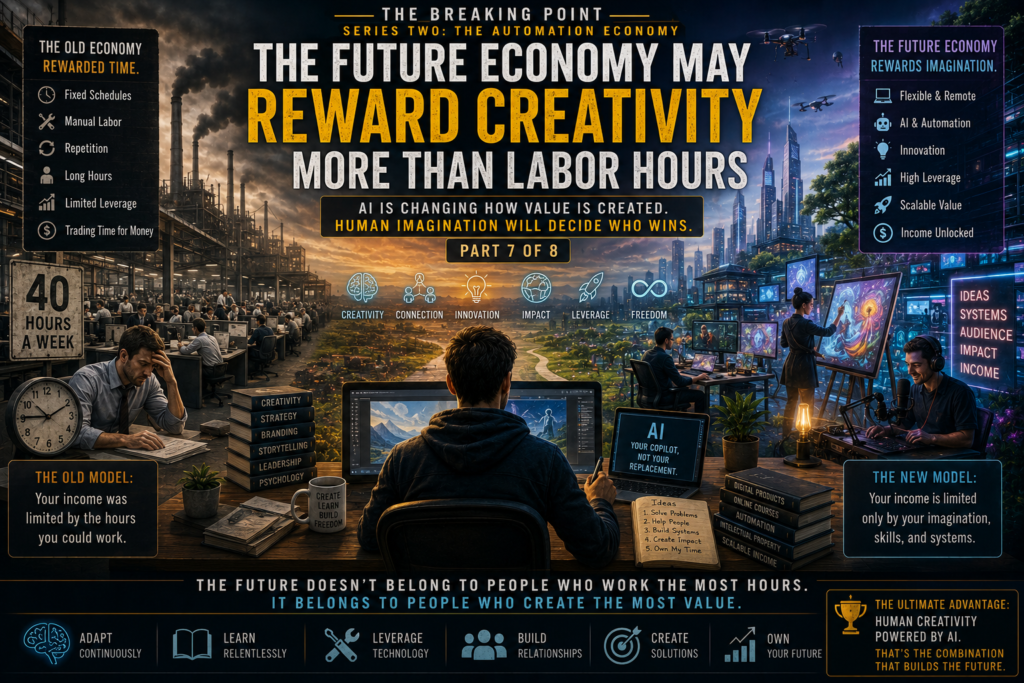
The Future Economy May Reward Creativity More Than Labor Hours
For generations, most people were taught a fairly simple formula for success.
Work hard.
Stay loyal.
Put in your time.
Eventually stability would follow.
That belief shaped much of modern society. Entire industries were built around schedules, labor hours, overtime, tenure, and predictable career progression. The economy rewarded consistency, endurance, and the ability to reliably perform repetitive work over long periods of time.
And for much of the industrial era, that model worked remarkably well.
But artificial intelligence may now be changing something much deeper than jobs alone.
It may be changing how economic value itself gets created.
And increasingly, the future economy may reward creativity, adaptability, leverage, and scalable thinking more aggressively than raw labor hours alone.
The Industrial Economy Was Built Around Time
The industrial economy depended heavily on human coordination.
Factories required workers physically present on production lines. Retail stores needed staff inside buildings. Transportation systems relied on schedules and manpower. Office environments depended on layers of administrative labor and repetitive processes.
The more efficiently organizations coordinated human hours, the more production expanded.
Time itself became one of the economy’s central measurements of value.
Even today, many compensation systems still revolve around:
- hours worked
- attendance
- tenure
- overtime
- physical presence
That structure made sense in a world where production scaled primarily through labor expansion.
But digital systems scale very differently.
And artificial intelligence may accelerate that shift faster than many institutions are prepared for.
AI Compresses Time
One of the most important changes artificial intelligence introduces is time compression.
Tasks that once required large teams and weeks of labor can increasingly be completed by highly capable individuals using AI-assisted systems.
Research that once took days may take minutes.
Marketing campaigns that once required departments can now be built by small teams.
Video editing, software development, customer interaction, scheduling, content creation, analysis, and operational workflows are all becoming increasingly automated or AI-enhanced.
That changes the relationship between effort and output.
A single person with the right tools may now produce the kind of economic value that previously required an entire organization.
That does not eliminate human importance.
But it dramatically amplifies highly adaptable individuals capable of leveraging technology effectively.
The Economy Is Beginning to Reward Different Human Skills
As repetitive labor becomes increasingly automated, human differentiation may shift toward areas where people still hold significant advantages over machines.
Creativity matters more.
Communication matters more.
Emotional intelligence matters more.
Vision matters more.
Artificial intelligence can generate information almost instantly. But information alone is no longer rare. In many ways, information itself is becoming abundant.
What becomes valuable is the ability to:
- interpret
- connect
- inspire
- build trust
- solve problems creatively
- and create meaning out of overwhelming amounts of information
That is a very different economic environment than the one many traditional systems were originally designed around.
Smaller Teams Will Likely Create Larger Results
One of the biggest shifts now emerging is leverage.
Historically, growth usually meant hiring more people.
Larger companies required larger workforces.
But artificial intelligence allows smaller teams to operate with dramatically greater efficiency.
A business that once required dozens of employees may eventually function with only a handful of highly skilled people supported by AI-enhanced systems.
That changes the economics of scale completely.
It changes hiring.
It changes education.
And it changes what skills become most valuable in the labor market.
The future workforce may not necessarily become smaller because humans lose value.
It may become smaller because technology multiplies the output of highly adaptable people.
Ownership May Matter More Than Ever
Another important shift involves ownership and leverage.
In highly scalable digital economies, the people who own:
- systems
- intellectual property
- audiences
- software
- platforms
- digital infrastructure
often gain disproportionate economic advantages compared to workers whose income remains tied entirely to hours worked.
That trend already exists today.
Artificial intelligence may accelerate it dramatically.
Because AI allows individuals and small organizations to scale faster than previous generations could have imagined.
A single creator can now potentially reach millions.
A small company can automate processes that once required layers of staff.
An entrepreneur can operate globally from a laptop.
That creates enormous opportunity.
But it also creates pressure for people still operating entirely inside traditional time-for-money systems.
Human Connection May Become More Valuable, Not Less
Ironically, the more technology advances, the more deeply human qualities may increase in value.
People still crave:
- trust
- leadership
- authenticity
- empathy
- emotional connection
- community
- inspiration
Artificial intelligence can automate many operational functions.
But it cannot fully replace human experience, human relationships, or genuine emotional connection.
That may explain why some future careers increasingly center around:
- advising
- leadership
- coaching
- storytelling
- entertainment
- relationship-driven business
- education
- and communication
As automation expands, human authenticity itself may become a premium asset.
This Transition Will Feel Uncomfortable
Every major economic transformation creates anxiety.
Especially when old rules stop feeling predictable.
People naturally fear becoming irrelevant. Workers worry whether their current skills will still matter. Entire industries feel uncertain about what the future may look like.
Those fears are understandable.
Because technological transitions rarely happen evenly.
Some people adapt quickly.
Others struggle.
And institutions almost always evolve slower than technology itself.
That tension may define much of the next decade.
The Danger Is Confusing Familiarity With Stability
One of the deeper risks during periods of transition is mistaking familiar systems for sustainable systems.
Some traditional labor structures feel stable simply because they are familiar.
But underneath the surface, many industries were already experiencing:
- burnout
- labor shortages
- scalability pressure
- rising costs
- operational instability
long before artificial intelligence accelerated.
AI is not necessarily creating all of that pressure.
In many cases, it is simply exposing which systems still scale efficiently…
and which ones were already becoming difficult to sustain long term.
Final Thoughts
Artificial intelligence is not simply changing jobs.
It may be changing how value itself gets created inside the economy.
The industrial era largely rewarded consistency, repetition, labor hours, and workforce expansion.
The emerging economy may increasingly reward:
- adaptability
- creativity
- ownership
- emotional intelligence
- leverage
- and scalable human contribution
That does not mean hard work stops mattering.
But it may mean the definition of productive work itself is evolving.
And the societies that adapt most successfully may not necessarily be the ones trying hardest to preserve every structure exactly as it existed before.
They may be the ones learning how to combine human creativity with technological leverage in ways that create opportunity, stability, and scalability at the same time.
Coming Next in The Automation Economy
Part 8 of 8
AI Isn’t the Threat — Collapse Is
We’ll conclude Series Two by examining why the deeper danger may not be artificial intelligence itself, but systems that fail to adapt while economic, technological, and demographic pressure continues building underneath them.
Hashtags:
#TheBreakingPoint #FutureOfWork #ArtificialIntelligence #AutomationEconomy #Creativity #AI #EconomicTransition #Innovation #Entrepreneurship #Leadership #DigitalEconomy #ScalableIncome #Technology #FutureEconomy #Ownership