

THE BREAKING POINT
Series Two — The Automation Economy
What Happens When the Math Stops Working
Part 8 of 8
AI Isn’t the Threat — Collapse Is
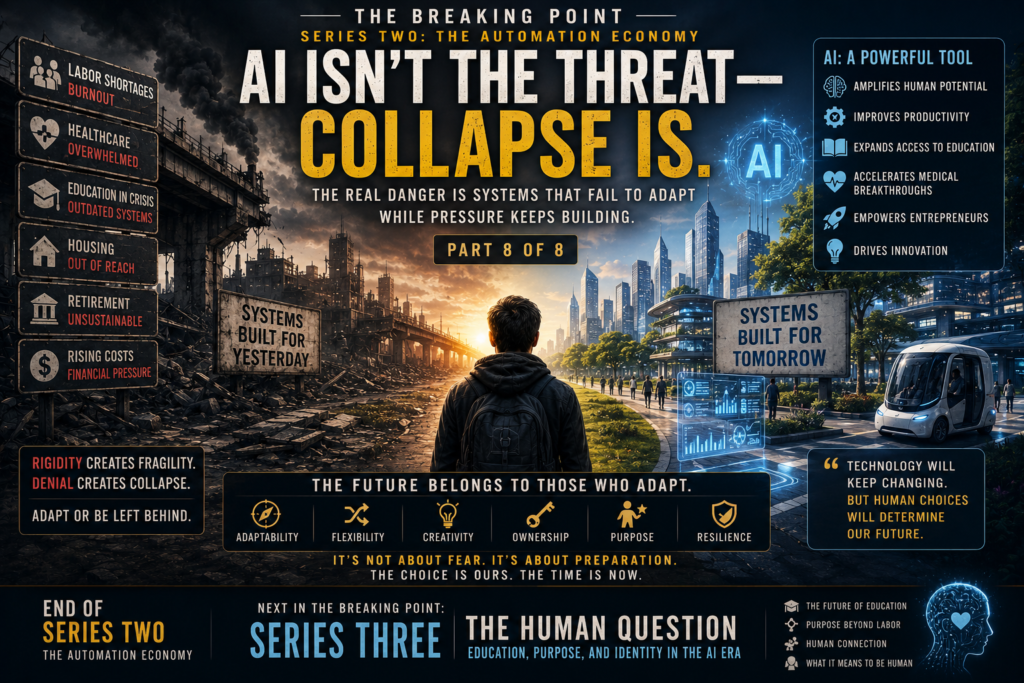
AI Isn’t the Threat — Collapse Is
Few technologies in modern history have generated more emotional reaction than artificial intelligence.
Some people see opportunity.
Others see danger.
Many fear a future where machines replace workers, eliminate stability, and fundamentally reshape society faster than institutions can adapt.
Those concerns are understandable because artificial intelligence is not a small technological shift. It may become one of the largest economic transformations since the Industrial Revolution itself.
But after exploring labor instability, burnout, demographic pressure, scalability, taxation, ownership, and the changing structure of work throughout this series, one conclusion becomes increasingly difficult to ignore:
Artificial intelligence itself may not be the greatest threat facing society.
The deeper danger may be systems failing to adapt while pressure continues building underneath them.
The Pressure Started Long Before AI
One of the biggest misconceptions surrounding automation is the idea that artificial intelligence suddenly created instability inside the economy.
In reality, much of the pressure already existed long before AI accelerated into public awareness.
Healthcare systems were already struggling with staffing shortages and exhaustion.
Education systems were already dealing with retention problems, burnout, and declining engagement.
Housing affordability was already becoming more difficult for younger generations.
Infrastructure systems were already aging.
Retirement obligations were already growing.
Operational costs were already rising.
Artificial intelligence did not create all of those problems.
In many ways, it simply arrived during a moment when many systems were already operating under increasing strain.
That distinction matters because it changes how we interpret what is happening.
AI may not be destroying stable systems.
It may be exposing systems that were already becoming difficult to sustain long term.
Technology Has Always Exposed Weakness Faster
Throughout history, technological transitions tend to expose structural weakness faster than societies expect.
When conditions remain stable, inefficient systems can survive for surprisingly long periods of time. Problems grow slowly. Pressure builds quietly. Institutions delay difficult reform because the urgency never fully arrives all at once.
But once technology creates a more scalable alternative, the pressure accelerates rapidly.
Organizations begin asking uncomfortable questions.
Can fewer people produce more?
Can operations become more predictable?
Can systems become less dependent on overtime, labor shortages, and burnout?
Can technology stabilize functions that humans are increasingly struggling to sustain consistently?
Those are not futuristic questions anymore.
Businesses, governments, hospitals, schools, and industries everywhere are already asking them.
The Real Danger Is Rigidity
One of the deeper lessons history repeatedly teaches is that societies rarely collapse simply because change occurs.
They become fragile when institutions stop adapting while conditions around them continue evolving.
That pattern has repeated during industrial revolutions, demographic shifts, economic transitions, and technological disruption throughout history.
The challenge is not change itself.
The challenge is whether systems remain flexible enough to evolve before the pressure underneath them becomes overwhelming.
And right now, many institutions appear caught between old operational models and rapidly changing economic realities.
That tension now appears almost everywhere:
- labor markets
- education
- healthcare
- infrastructure
- housing
- taxation
- workforce participation
- and even cultural expectations surrounding work itself
The speed of change is what makes the moment feel unstable.
AI Is Accelerating Reality
Artificial intelligence is not just accelerating productivity.
It is accelerating reality.
It exposes inefficiency faster.
It exposes scalability problems faster.
It exposes operational fragility faster.
It exposes outdated systems faster.
And unlike previous technological transitions that unfolded across generations, AI is evolving at digital speed.
That may be one of the most psychologically difficult aspects of the modern transition.
People no longer feel like they have decades to slowly adapt.
Entire industries now feel pressure to evolve almost simultaneously.
That creates anxiety even among highly educated and economically successful people because uncertainty itself spreads faster than most institutions are prepared to absorb.
People Fear Losing Their Place in the Economy
Underneath most automation debates sits a deeply human fear.
People fear becoming economically irrelevant.
For generations, work provided more than income alone. It created identity, structure, purpose, stability, community, and a sense of contribution.
If artificial intelligence changes how economic value gets created faster than society adapts, many people naturally begin questioning where they fit inside the future economy.
That fear should not be dismissed lightly.
Because societies become unstable when large groups of people begin feeling disconnected from meaningful participation, ownership, and opportunity.
The challenge of the AI era may not simply involve preserving jobs.
It may involve preserving human dignity during periods of rapid technological transition.
Efficiency Alone Cannot Sustain Society
One of the biggest risks of the modern economy is becoming so focused on optimization that society forgets the importance of:
- purpose
- mobility
- opportunity
- stability
- and human connection
Highly efficient systems do not automatically create healthy societies.
People still need to believe:
- effort matters
- improvement is possible
- ownership remains achievable
- and the future still contains opportunity
That may become one of the defining leadership challenges of the next generation.
How do societies embrace technological advancement without creating widespread emotional instability in the process?
That question may ultimately matter more than artificial intelligence itself.
Adaptation May Become the Defining Human Skill
If there is one consistent theme emerging throughout this entire series, it may be this:
The future likely belongs to adaptable people, adaptable businesses, and adaptable systems.
Not necessarily the largest.
Not necessarily the most powerful today.
But the most flexible.
The most scalable.
The most capable of evolving while conditions continue changing around them.
Because the modern economy is no longer standing still long enough for rigid systems to remain comfortable indefinitely.
And the pressure underneath many traditional structures continues building whether society feels emotionally prepared for it or not.
This Transition Will Create Opportunity Too
It is important not to frame the future entirely through fear.
Every major technological transformation in history also created extraordinary opportunity.
Artificial intelligence may dramatically improve:
- medical research
- education access
- productivity
- entrepreneurship
- communication
- innovation
- and individual scalability
Small teams may accomplish extraordinary things.
Creative individuals may build businesses faster than previous generations ever imagined possible.
People capable of combining human creativity with technological leverage may unlock entirely new forms of opportunity.
The future will likely contain both disruption and expansion simultaneously.
That complexity is what makes this moment so difficult to fully understand while living through it.
The Greatest Risk May Be Waiting Too Long
Perhaps the biggest danger of all is denial.
Pretending old systems can continue functioning indefinitely without meaningful adaptation while economic, demographic, and technological conditions continue changing underneath them.
Because once pressure compounds long enough, transitions often become far more chaotic than they needed to be.
That is true for governments.
Businesses.
Education systems.
Labor markets.
And individuals alike.
The longer adaptation gets delayed, the harder adjustment often becomes later.
Final Thoughts
Artificial intelligence is not inherently good or evil.
It is a tool.
An extremely powerful tool.
But tools tend to amplify the strengths and weaknesses already existing inside systems.
And right now, many systems are already carrying enormous pressure beneath the surface.
Burnout.
Labor shortages.
Aging populations.
Scalability problems.
Rising costs.
Operational instability.
Changing workforce expectations.
Artificial intelligence did not create all of that.
But it is exposing those pressures faster than society may have been emotionally prepared to confront them.
That is why the deeper threat may not be artificial intelligence itself.
The deeper threat may be systems failing to evolve while the world around them changes anyway.
Because history rarely waits for societies to feel fully ready before transformation begins.
And whether people embrace that reality or resist it, the transition is already underway.
End of Series Two
The Automation Economy
Next in The Breaking Point:
Series Three
The Human Question
Education, Purpose, and Identity in the AI Era
We’ll explore the future of education, AI-assisted learning, work-life balance, social media psychology, human connection, purpose beyond labor, and what it means to remain deeply human in a world increasingly shaped by intelligent machines.
Hashtags:
#TheBreakingPoint #ArtificialIntelligence #AutomationEconomy #FutureOfWork #AI #EconomicTransition #Leadership #Technology #FutureEconomy #Innovation #Workforce #HumanAdaptation #Scalability #EconomicReality #FutureSociety