

THE BREAKING POINT
Infrastructure at the Breaking Point — Part 6 of 10
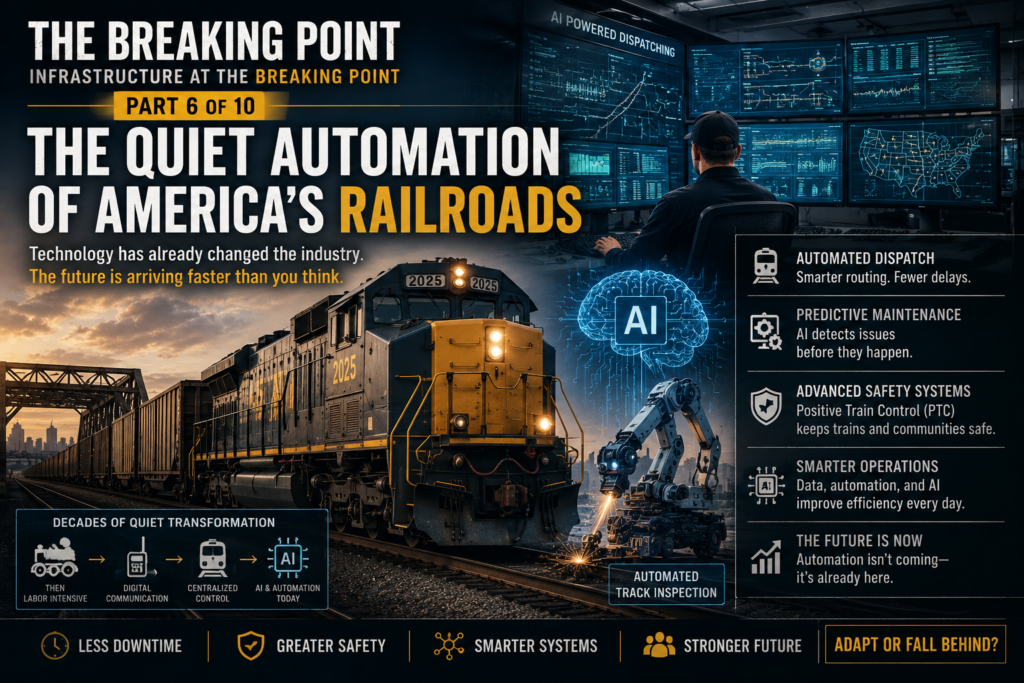
The Quiet Automation of America’s Railroads
Previously in The Breaking Point
In Part 1, we explored how the Long Island Rail Road strike exposed growing operational pressure beneath America’s infrastructure systems.
In Part 2, we examined how overtime quietly evolved into a permanent operating model across many industries.
In Part 3, we looked at retirement sustainability and growing worker-to-retiree pressure.
In Part 4, we examined how public systems can delay financial pressure longer than private companies through taxes, debt, and political protection.
In Part 5, we looked at how Detroit became an early warning sign for what happens when labor costs, pension pressure, automation, and competition collide faster than systems can adapt.
Now we move into another uncomfortable reality:
Automation in America’s railroads did not suddenly begin with artificial intelligence.
It has already been happening quietly for decades.
The Quiet Automation of America’s Railroads
Most passengers stepping onto a train never notice how much of the railroad industry has already been automated.
They see:
- conductors
- engineers
- ticket agents
- maintenance crews
But behind the scenes, modern railroads increasingly depend on:
- computerized dispatching
- automated signaling
- predictive maintenance systems
- digital scheduling
- AI-assisted monitoring
- advanced safety technology
The railroad industry has been reducing labor dependency for generations.
Most people simply did not notice because it happened slowly.
Railroads Were Once Extremely Labor Intensive
At one time, railroads required enormous workforces to operate.
Entire crews handled:
- switching operations
- signaling
- manual inspections
- communication
- ticketing
- scheduling
- maintenance
- braking systems
Railroad yards were packed with workers.
Communication often relied heavily on:
- radios
- paperwork
- manual coordination
- visual signaling
The industry depended on massive labor infrastructure simply to keep trains moving safely.
Technology Quietly Eliminated Thousands of Jobs
Over time, railroads steadily modernized operations.
And each wave of modernization reduced labor needs.
Jobs slowly disappeared through:
- computerized dispatch systems
- automated switching
- electronic monitoring
- centralized traffic control
- digital communications
- automated ticketing
- more efficient locomotives
Even the caboose largely disappeared from modern freight rail.
Many passengers never realized how much automation had already transformed the industry long before AI became a mainstream conversation.
Safety Became a Major Driver of Automation
One of the biggest reasons railroads embraced technology was safety.
Human fatigue, communication breakdowns, and operational error can create catastrophic consequences in transportation systems.
That led to enormous investment in:
- signaling systems
- monitoring technology
- automated braking
- digital communication systems
- safety enforcement tools
One major example is:
Positive Train Control (PTC)
PTC systems help:
- automatically slow trains
- prevent certain collisions
- monitor speed restrictions
- reduce human error risks
This was not just about efficiency.
It was also about reducing operational risk.
Predictive Maintenance Is Changing Everything
One of the least visible forms of railroad automation today is predictive maintenance.
Modern rail systems increasingly use:
- sensors
- AI monitoring
- automated diagnostics
- thermal scanners
- digital inspection systems
These technologies can identify:
- wheel defects
- overheating components
- track problems
- mechanical failures
…before catastrophic breakdowns occur.
Historically, many inspections depended heavily on human observation.
Today, railroads increasingly rely on data-driven systems capable of monitoring thousands of operational variables in real time.
That dramatically changes staffing needs over time.
AI Is Becoming the Next Layer
Artificial intelligence is now accelerating the next phase of railroad automation.
AI systems are increasingly being used to:
- optimize scheduling
- reduce delays
- improve routing
- predict maintenance failures
- monitor fuel efficiency
- analyze operational data
- identify safety risks
And unlike earlier automation waves, AI continuously improves as systems process more data.
That creates a major shift.
Because now automation is not just replacing repetitive physical tasks.
It is increasingly assisting operational decision-making itself.
The Engineer Debate Is Coming
One of the most controversial future discussions involves train engineers themselves.
Today, most Americans still expect:
- engineers
- conductors
- onboard crews
to remain essential.
And for now, they largely are.
But the technology required for partially autonomous rail systems already exists in many forms.
Some transit systems around the world already operate:
- driver-assisted trains
- semi-autonomous systems
- fully automated transit lines
The question is no longer:
“Is automation possible?”
The question is:
“When does the economic pressure become strong enough to accelerate adoption?”
That is a very different conversation.
Burnout and Labor Pressure Accelerate Automation
This is the pattern many industries are now facing.
Automation rarely accelerates in stable environments.
It accelerates when systems experience:
- labor shortages
- rising costs
- burnout
- staffing instability
- retirement pressure
- operational inefficiency
That pressure creates incentive.
And once enough pressure builds, technology investment becomes easier to justify politically and financially.
The railroad industry may simply be entering another major acceleration phase.
Most Automation Happens Quietly
One reason automation discussions become emotionally confusing is because people often imagine dramatic overnight replacement.
But historically, automation rarely works that way.
Instead:
- one role gets reduced
- one task becomes digital
- one process becomes centralized
- one department becomes smaller
Then years later, people suddenly realize the workforce structure looks completely different than it once did.
That is how most industrial transformation actually happens.
Quietly.
Gradually.
Then suddenly obvious in hindsight.
The Real Issue Is Sustainability
The deeper railroad automation discussion is not really about whether workers matter.
Workers absolutely matter.
The deeper issue is whether systems under pressure can continue scaling through traditional labor structures alone.
Because railroads now face:
- retirement pressure
- burnout
- labor shortages
- overtime dependency
- operational complexity
- rising costs
- public pressure
- political pressure
At some point, organizations begin asking:
“What functions can technology stabilize?”
That question is becoming increasingly unavoidable.
Final Thoughts
The future of railroad automation is not science fiction anymore.
Much of it is already here.
The industry has already spent decades reducing labor dependency through:
- digital systems
- predictive maintenance
- centralized control
- safety automation
- operational technology
Artificial intelligence may simply become the next acceleration layer.
That does not mean humans suddenly disappear from railroads.
But it does mean the economics surrounding labor, safety, scalability, and operational stability are changing rapidly.
And history suggests something important:
Once industries discover technology can stabilize systems under pressure…
the pressure itself often accelerates adoption far faster than people expect.
Coming Next in The Breaking Point
Part 7 of 10
The Day Labor Became More Expensive Than Automation
We’ll examine:
- economic tipping points
- labor scalability
- AI economics
- staffing instability
- and the moment technology begins looking cheaper, safer, and more predictable than the systems it replaces.
Hashtags:
#TheBreakingPoint #RailroadAutomation #ArtificialIntelligence #AI #FutureOfWork #Automation #Infrastructure #Railroads #PredictiveMaintenance #Transportation #EconomicReality #Burnout #OperationalEfficiency #Technology #Labor