

The Long Island Rail Road strike has quickly become another political battlefield.
Some blame management.
Some blame unions.
Some blame inflation.
Some blame politicians.
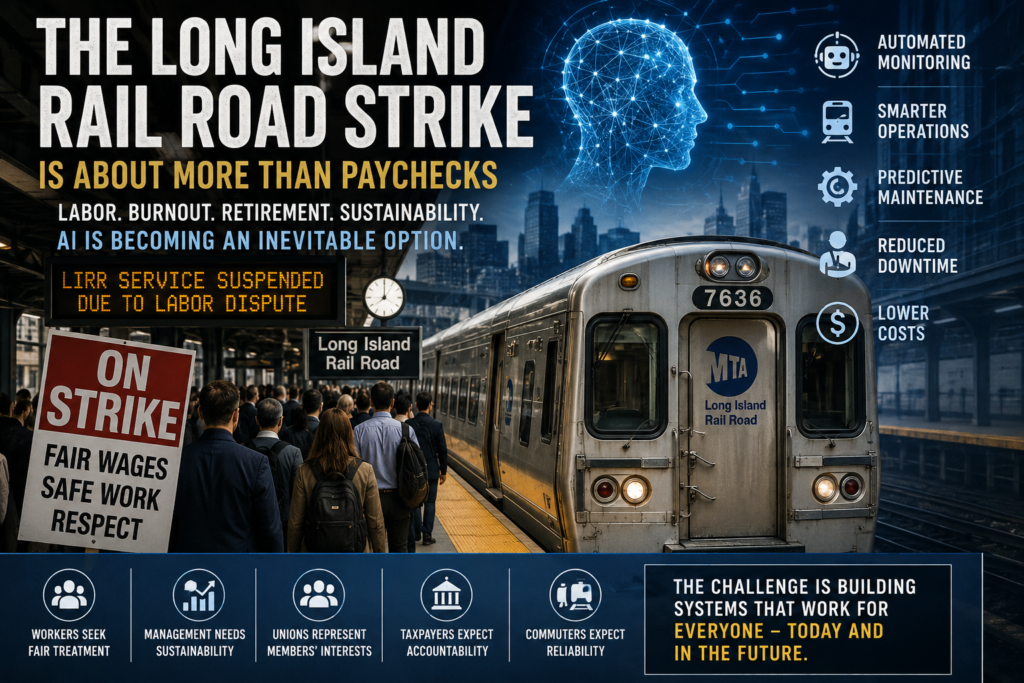
But after looking deeper into the numbers, operations, and long-term pressures surrounding modern infrastructure systems, I believe this strike represents something much bigger than a contract dispute.
It may be a warning sign that many of America’s critical systems are approaching a breaking point between:
- labor
- burnout
- retirement obligations
- operational sustainability
- and the growing inevitability of automation and artificial intelligence.
This is not simply a story about greedy corporations or greedy workers.
The reality is far more complicated than that.
Every Part of the System Has Incentives
One thing I think many Americans overlook is that every major player in these systems has its own responsibilities and incentives.
Corporations answer to:
- investors
- shareholders
- retirement funds
- pension accounts
Management answers to:
- operational performance
- labor costs
- customer satisfaction
- budgets
- long-term sustainability
Unions answer to:
- membership
- negotiated compensation
- protections
- working conditions
- organizational growth
Politicians answer to:
- voters
- public pressure
- budgets
- elections
None of these groups operate entirely from pure idealism.
They all respond to incentives.
And eventually those incentives can begin colliding with one another.
The Railroad Didn’t Reach This Point Overnight
The Long Island Rail Road strike did not suddenly appear out of nowhere.
The pressure has likely been building for decades through:
- rising overtime dependency
- retirement obligations
- staffing shortages
- burnout
- inflation
- healthcare costs
- aging infrastructure
- delayed reforms
Most people only notice the problem once the trains stop running.
But by then, the stress inside the system has usually been building quietly for years.
Overtime Is No Longer “Extra”
One issue that keeps surfacing in public infrastructure systems is overtime.
At one time overtime was designed for:
- emergencies
- unexpected demand
- temporary shortages
But in many industries today, overtime has quietly become part of the operational model itself.
That changes the conversation completely.
When systems rely heavily on overtime:
- labor costs increase dramatically
- fatigue grows
- burnout accelerates
- younger workers become frustrated
- retirement liabilities rise
- public trust declines
And perhaps most importantly:
predictable staffing shortages become normalized.
That is not a temporary labor issue anymore.
That becomes an operational issue.
Public Systems Operate Differently Than Private Companies
One important difference between public systems and private companies is how financial pressure works.
Private companies eventually face direct market consequences if:
- costs rise too fast
- operations become inefficient
- customers leave
- competitors outperform them
Public systems can often continue operating through:
- taxpayer support
- subsidies
- debt
- fare increases
- government backing
That does not mean public workers are the problem.
It simply means public systems can delay operational reality longer than private companies sometimes can.
But delayed problems are not solved problems.
Eventually the pressure surfaces somewhere.
This strike may be one of those moments.
Burnout Is Becoming a National Problem
One issue I believe America is underestimating is burnout.
This is happening across:
- railroads
- healthcare
- education
- police departments
- utilities
- aviation
- logistics
Many essential systems are increasingly being held together by experienced workers carrying unsustainable workloads.
That creates:
- fatigue
- turnover
- staffing shortages
- operational instability
And in transportation systems especially, fatigue becomes more than a workplace issue.
It becomes a public safety issue.
AI Is Becoming an Operational Decision
Most people discuss artificial intelligence emotionally.
But inside large operational systems, AI increasingly becomes an economic and operational discussion.
When organizations face:
- labor shortages
- retirement pressures
- burnout
- overtime dependency
- inconsistent staffing
…automation starts becoming attractive not because companies hate workers, but because leaders start searching for long-term stability.
The railroad industry has already automated enormous portions of operations over the last century through:
- computerized dispatching
- digital ticketing
- automated monitoring
- predictive maintenance
- Positive Train Control systems
The process has already started.
The real question is how far it eventually goes.
The Real Issue May Be Sustainability
I do not believe this conversation should be framed as:
workers versus management.
Nor should it be framed as:
unions versus corporations.
The deeper issue may be whether America’s current labor and operational models remain sustainable in the decades ahead.
Because eventually:
- rising labor costs
- retirement obligations
- overtime dependence
- burnout
- taxpayer fatigue
- political pressure
- advancing AI capability
…all begin colliding at the same time.
And when they do, difficult conversations become unavoidable.
Final Thoughts
The Long Island Rail Road strike is not just about paychecks.
It is about pressure building inside systems that millions of Americans depend on every single day.
Workers deserve fair treatment.
Management has operational responsibilities.
Taxpayers expect sustainability.
Commuters expect reliability.
And technology continues advancing whether society feels comfortable with it or not.
The challenge moving forward may not be choosing between workers and automation.
The real challenge may be figuring out how to build systems that remain:
- sustainable
- accountable
- efficient
- and human at the same time.
Hashtags:
#LongIslandRailRoad #RailroadStrike #Infrastructure #ArtificialIntelligence #FutureOfWork #Labor #Automation #Burnout #Overtime #PublicTransit #EconomicReality #AI #Technology #Leadership #OperationalEfficiency