

THE BREAKING POINT
Infrastructure at the Breaking Point — Part 5 of 10
The Detroit Warning America Ignored
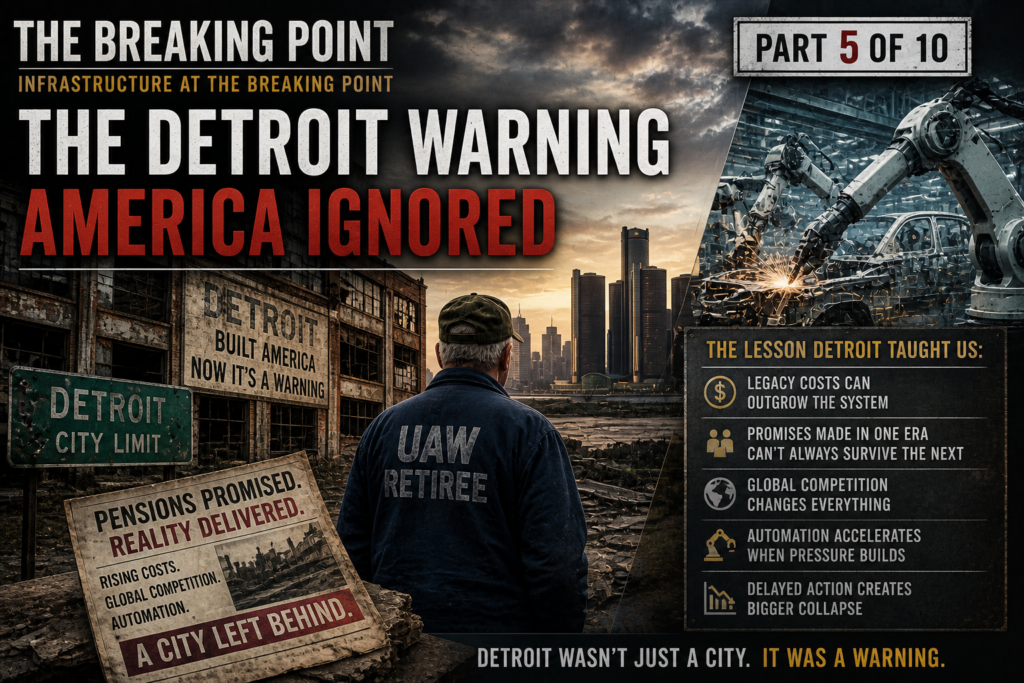
Previously in The Breaking Point
In Part 1, we explored how the Long Island Rail Road strike exposed growing operational pressure beneath America’s infrastructure systems.
In Part 2, we examined how overtime quietly evolved into a permanent operating model across many industries.
In Part 3, we looked at retirement sustainability and the growing pressure created by shrinking worker-to-retiree ratios.
In Part 4, we explored how public systems can often delay financial reality longer than private companies through taxes, debt, subsidies, and political protection.
Now we move into one of America’s most important economic warning stories:
Detroit.
Because long before today’s conversations about AI, burnout, automation, and labor sustainability, the Detroit labor crisis was already exposing many of the same structural pressures America is facing today.
The Detroit Warning America Ignored
For decades, Detroit represented the power of American industry.
Factories roared.
Assembly lines moved endlessly.
Middle-class families flourished.
And generations of workers built stable lives through the American auto industry.
Companies like:
- General Motors
- Ford Motor Company
- Chrysler
…helped define the American dream.
Strong wages.
Strong unions.
Strong benefits.
Strong retirement systems.
But underneath that prosperity, economic pressure was quietly building.
And eventually the math started catching up.
The Detroit labor crisis did not happen overnight.
It developed slowly through decades of rising obligations, changing markets, increasing automation in manufacturing, and global competition that reshaped the entire industry.
The Cost of Success
One of the hardest realities in labor economics is that success itself can eventually create pressure.
As the auto industry expanded, companies accumulated growing obligations:
- pensions
- retiree healthcare
- long-term labor agreements
- legacy labor costs
- expanding operational expenses
At the time, many of those promises appeared sustainable.
America dominated manufacturing.
Demand remained high.
Growth appeared endless.
Few people imagined how quickly global competition and automation in manufacturing would reshape the industry.
The Detroit labor crisis became a warning sign of what happens when systems built during one economic era face an entirely different competitive environment.
Global Competition Changed Everything
Eventually foreign automakers entered the market aggressively.
Companies like:
- Toyota
- Honda
- Nissan
…began competing with:
- lower production costs
- leaner operations
- newer manufacturing systems
- different labor structures
- advanced efficiency models
American automakers suddenly faced a reality they had not fully prepared for:
The market no longer guaranteed dominance.
And once competition intensified, legacy costs became far more difficult to absorb.
That shift accelerated the Detroit labor crisis dramatically.
Pension Pressure and Retiree Costs Exploded
One issue many Americans never fully understood was how much pension pressure and retiree healthcare costs affected the auto industry financially.
Over time, automakers were supporting:
- large retired workforces
- healthcare plans
- pension systems
- negotiated labor agreements
At one point, estimates suggested retiree healthcare and pension obligations added well over $1,000 to the cost of some vehicles before they ever reached the dealership.
That became a major competitive disadvantage.
Especially against companies operating with:
- younger workforces
- different retirement structures
- lower legacy obligations
- more scalable labor systems
The Detroit labor crisis was no longer simply about wages.
It became a sustainability issue.
Automation in Manufacturing Accelerated
This is where many people misunderstand automation historically.
Automation in manufacturing often accelerates when industries face operational pressure.
The auto industry increasingly turned toward:
- robotics
- advanced manufacturing systems
- assembly-line automation
- predictive technology
- operational efficiency tools
Not simply because companies disliked workers.
But because:
- labor costs were rising
- global competition intensified
- scalability mattered
- profit margins tightened
- survival became harder
The economics changed.
And once the economics changed, automation became increasingly attractive.
The Detroit labor crisis became one of the clearest examples of how economic pressure can accelerate technological transformation.
Detroit Became a Symbol of Industrial Decline
Over time, Detroit stopped symbolizing unstoppable industrial growth.
Instead, it became associated with:
- factory closures
- economic decline
- population loss
- pension pressure
- abandoned buildings
- shrinking tax bases
- rising financial instability
The city became a warning sign of what can happen when:
- long-term obligations outgrow sustainability
- systems fail to adapt fast enough
- economic pressure accelerates faster than reform
That does not erase the incredible contributions made by generations of workers.
But it does reveal how fragile even powerful systems can become when conditions change faster than institutions can evolve.
The Human Side of the Detroit Labor Crisis
One of the biggest mistakes people make when discussing the Detroit labor crisis is reducing everything to numbers.
Behind every factory closure were:
- families
- communities
- retirees
- neighborhoods
- identities tied to generations of industrial work
For many workers, these were not simply jobs.
They represented:
- stability
- purpose
- pride
- opportunity
- multigenerational livelihoods
When industries decline, entire communities can feel abandoned.
That emotional reality matters.
Because labor discussions are never purely economic.
They are deeply human.
The Same Pressures Are Reappearing Across America
That is what makes Detroit such an important warning today.
Many of the same pressures from the Detroit labor crisis are now appearing across:
- transportation
- public infrastructure
- education
- healthcare
- logistics
- manufacturing
Including:
- burnout
- retirement pressure
- staffing shortages
- rising labor costs
- operational inefficiency
- automation incentives
The industries may differ.
But the underlying economic pressure often looks remarkably similar.
AI Is the Next Industrial Transformation
Artificial intelligence may become the next major acceleration point.
Not because AI magically solves every problem.
But because organizations increasingly face:
- labor instability
- aging workforces
- burnout
- rising costs
- scalability challenges
- retirement obligations
Once systems begin struggling financially, investment in automation and AI becomes easier to justify.
That is exactly what happened during earlier manufacturing automation waves.
The pressure created the incentive.
And the incentive accelerated technological adoption.
The Real Lesson From Detroit
The deeper lesson from the Detroit labor crisis is not:
“Unions destroyed Detroit.”
Nor is it:
“Corporations destroyed Detroit.”
The real lesson may be this:
Systems built during one economic era often struggle when the rules of that era fundamentally change.
Detroit was built during:
- industrial expansion
- American manufacturing dominance
- strong population growth
- different global competition
- different labor economics
But globalization, automation, demographics, pension pressure, and changing economics rewrote the environment faster than many systems could adapt.
That is the warning.
Final Thoughts
Detroit matters because it reminds America that even powerful systems can become vulnerable when:
- costs rise faster than productivity
- pension pressure outgrows scalability
- reform gets delayed
- automation changes the competitive landscape
- labor structures stop adapting to economic reality
The people who built America’s industrial backbone deserve enormous respect.
But respect alone does not eliminate economic pressure.
And ignoring pressure does not stop it from growing.
That may be the deeper warning Detroit still offers America today.
Not just about manufacturing.
But about what happens when systems postpone adaptation while the world around them keeps changing.
Coming Next in The Breaking Point
Part 6 of 10
The Quiet Automation of America’s Railroads
We’ll examine how railroads have already spent decades reducing labor dependency through:
- automation
- computerized dispatching
- predictive maintenance
- digital systems
- operational technology most passengers never even notice
The future may already be arriving far more quietly than most people realize.
Hashtags:
#TheBreakingPoint #DetroitLaborCrisis #Automation #ArtificialIntelligence #Manufacturing #FutureOfWork #Burnout #Infrastructure #EconomicReality #AI #PensionPressure #OperationalEfficiency #AmericanIndustry #Labor #Workforce