

THE BREAKING POINT
Infrastructure at the Breaking Point — Part 4 of 10
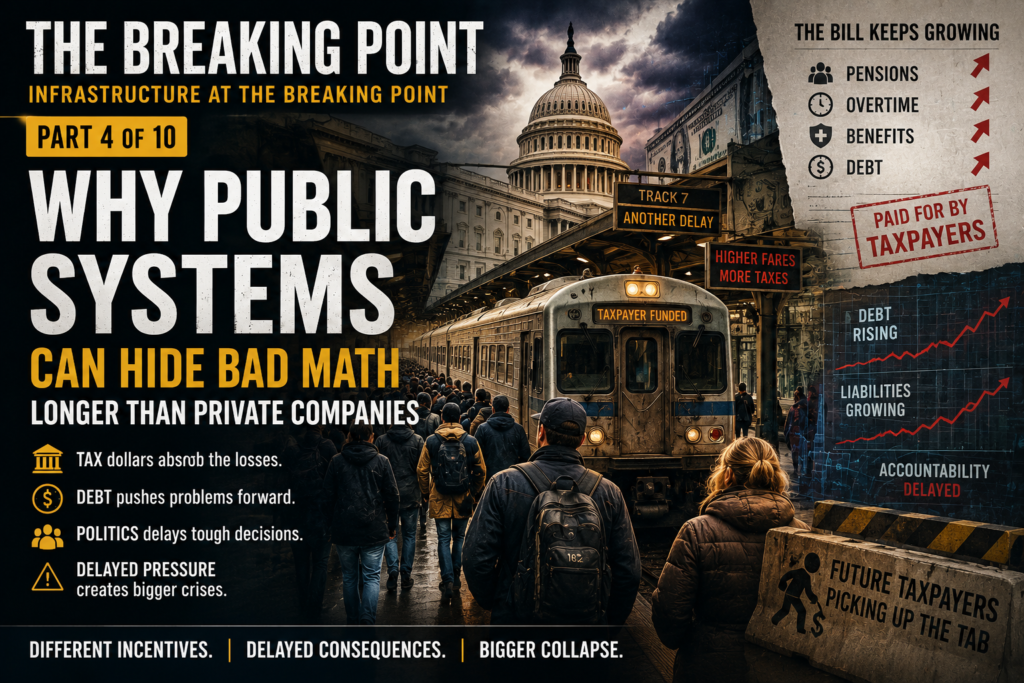
Why Public Systems Can Hide Bad Math Longer Than Private Companies
Previously in The Breaking Point
In Part 1, we explored how the Long Island Rail Road strike exposed deeper operational pressure building beneath America’s infrastructure systems.
In Part 2, we examined how overtime quietly evolved from an occasional necessity into a permanent operating model across many critical industries.
In Part 3, we looked at how retirement obligations, shrinking worker-to-retiree ratios, and burnout are creating long-term financial pressure many systems may struggle to sustain.
Now the conversation moves into another uncomfortable reality:
Why public systems can often continue operating long after private companies would have been forced to change course.
One of the biggest differences between public systems and private businesses is how financial pressure works.
Private companies usually face consequences quickly.
If:
- labor costs rise too fast
- customers leave
- operations become inefficient
- debt grows unsustainably
- competitors outperform them
…the market responds.
Profits shrink.
Stock prices fall.
Layoffs happen.
Restructuring begins.
Or in some cases, the company fails entirely.
Public systems operate very differently.
And that difference changes everything.
Public Systems Have Backstops
Many public systems continue functioning through:
- taxpayer funding
- subsidies
- government borrowing
- public bonds
- fare increases
- federal support
That does not automatically make them bad systems.
In many cases, critical infrastructure should be protected because society depends on it.
The issue is not whether public systems matter.
The issue is what happens when operational pressure can be delayed almost indefinitely.
Because delayed pressure often creates the illusion that the underlying math is sustainable.
Sometimes it isn’t.
The Market Forces Are Different
A private company can only raise prices so far before customers leave.
Public systems often operate differently because:
- taxpayers absorb losses
- governments refinance debt
- political leaders postpone difficult decisions
- service reductions become politically risky
That creates a very different incentive structure.
In some situations, operational inefficiency can survive far longer than it could in a purely competitive market.
But survival and sustainability are not always the same thing.
Politics Changes Decision Making
Another major difference is political influence.
Private companies answer primarily to:
- customers
- investors
- competition
- profitability
Public systems answer to:
- politicians
- unions
- taxpayers
- voters
- media pressure
- public perception
That creates competing priorities that can sometimes slow operational reform dramatically.
For example:
- staffing reductions become political fights
- overtime reform becomes controversial
- pension restructuring becomes emotionally explosive
- fare increases create public backlash
And because elected officials often operate on election cycles, long-term structural issues can become easier to delay than solve.
Delayed Problems Usually Grow Larger
This may be one of the most dangerous aspects of public-system economics.
When pressure is delayed:
- debt can continue growing
- overtime structures become normalized
- retirement liabilities expand
- infrastructure ages
- burnout spreads
- staffing shortages worsen
The system keeps functioning…
until suddenly the pressure becomes impossible to ignore.
At that point, the required fixes often become:
- more painful
- more expensive
- more politically divisive
That is why delayed operational reality can sometimes create larger long-term instability.
Taxpayers Eventually Notice
Most taxpayers are willing to support critical systems when they believe:
- services are reliable
- operations are responsible
- leadership is accountable
- workers are treated fairly
But frustration grows when the public sees:
- rising fares
- higher taxes
- aging infrastructure
- constant delays
- endless overtime
- growing debt
- and little visible improvement
At some point people begin asking:
“Where is all the money going?”
That question becomes politically powerful very quickly.
Especially during periods of:
- inflation
- economic uncertainty
- housing pressure
- rising living costs
Public Systems Still Need Skilled Workers
One mistake some people make is assuming this conversation means public workers are unnecessary.
That is not true at all.
Society absolutely depends on:
- railroad workers
- utility crews
- teachers
- nurses
- firefighters
- police officers
- transportation employees
These are essential functions.
The challenge is figuring out how to maintain:
- service quality
- worker sustainability
- operational efficiency
- and financial stability
…all at the same time.
That balance becomes increasingly difficult when labor shortages and retirement pressure continue growing.
AI Changes the Pressure Curve
Artificial intelligence and automation are quietly changing this conversation.
Not because AI solves every problem.
And not because workers suddenly become irrelevant.
But because organizations under financial pressure begin searching aggressively for:
- efficiency
- scalability
- predictability
- operational stability
AI systems are already helping:
- optimize staffing
- predict maintenance
- reduce downtime
- automate monitoring
- streamline scheduling
- improve operational forecasting
The more financially unstable systems become, the stronger the incentive grows to reduce dependence on expensive and unpredictable labor structures.
That does not eliminate the human need entirely.
But it absolutely changes the economic calculations.
The Real Issue Is Sustainability
The debate surrounding public systems often becomes emotional very quickly.
Some blame unions.
Some blame politicians.
Some blame management.
Some blame taxpayers.
But the deeper issue may be structural.
Many systems were built during:
- different demographic periods
- different labor markets
- different economic realities
- different technological limitations
The question now becomes:
“Can those same structures continue scaling under modern pressure?”
That may be the real challenge America is approaching.
Final Thoughts
Public systems are not failing because workers are lazy.
And private companies are not automatically efficient simply because they operate for profit.
Every institution responds to incentives.
The danger begins when incentives drift too far away from:
- accountability
- sustainability
- operational reality
- and long-term scalability
Public systems can often delay pressure longer than private companies.
But delayed pressure does not disappear.
Eventually:
- debt grows
- burnout spreads
- labor shortages intensify
- taxpayers push back
- and operational instability becomes visible
The question is not whether these systems matter.
The question is whether they can evolve fast enough to remain sustainable in the decades ahead.
Coming Next in The Breaking Point
Part 5 of 10
The Detroit Warning America Ignored
We’ll examine how America’s auto industry became an early warning sign for:
- pension pressure
- retiree healthcare costs
- labor economics
- automation
- and what happens when long-term obligations collide with global competition.
Hashtags:
#TheBreakingPoint #Infrastructure #PublicSystems #ArtificialIntelligence #Automation #Burnout #EconomicReality #FutureOfWork #PublicTransit #Leadership #Labor #Taxpayers #OperationalEfficiency #RetirementCrisis #AI