

THE BREAKING POINT
Infrastructure at the Breaking Point — Part 7 of 10
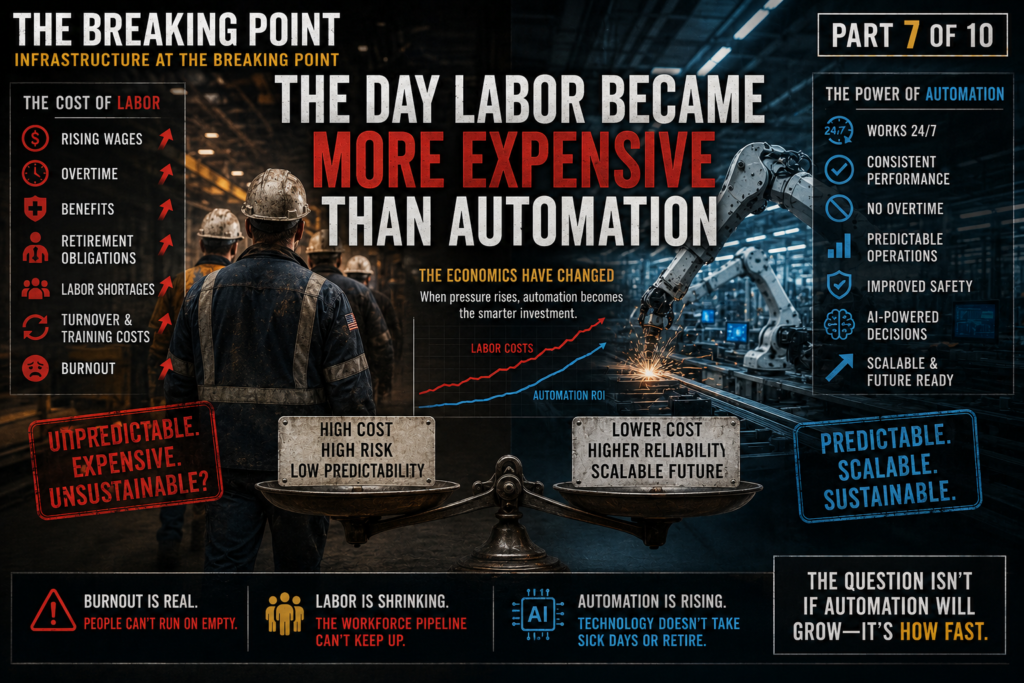
The Day Labor Became More Expensive Than Automation
Previously in The Breaking Point
In Part 1, we explored how the Long Island Rail Road strike revealed growing pressure beneath America’s infrastructure systems.
In Part 2, we examined how overtime evolved into a permanent operational model across many industries.
In Part 3, we looked at retirement sustainability and growing worker-to-retiree pressure.
In Part 4, we explored how public systems can delay financial pressure through taxes, subsidies, and debt.
In Part 5, we looked at how Detroit became an early warning sign for what happens when labor costs, pension obligations, and automation collide faster than systems can adapt.
In Part 6, we explored how railroad automation has already been quietly transforming infrastructure for decades.
Now we arrive at one of the most uncomfortable realities in the entire series:
The moment organizations begin deciding that automation may be cheaper, safer, and more scalable than the labor structures they currently depend on.
The Day Labor Became More Expensive Than Automation
For most of modern history, human labor was the most flexible operational tool businesses could use.
People adapted.
People solved problems.
People handled unpredictability.
And for decades, labor remained cheaper than most large-scale automation investments.
But that equation is beginning to change rapidly.
Not because workers suddenly became unnecessary.
And not because companies stopped valuing people.
The economics themselves are changing.
Rising Labor Costs Are Reshaping Decision Making
Across America, organizations are increasingly facing:
- rising wages
- overtime dependency
- retirement obligations
- healthcare costs
- staffing shortages
- burnout
- training costs
- turnover instability
Individually, each issue may appear manageable.
But together, they dramatically increase operational pressure.
At some point leadership teams begin asking:
“Can this system continue scaling long term?”
That question is now appearing across:
- transportation
- manufacturing
- logistics
- retail
- healthcare
- public infrastructure
- education
And increasingly, the answer is pushing companies toward technology investment.
Automation Never Sleeps
One reason automation economics become attractive is because machines operate differently than human labor systems.
Automation does not:
- call in sick
- burn out
- retire
- require overtime
- demand shift coverage
- require healthcare
- experience emotional fatigue
That does not make humans less valuable.
Humans still outperform machines in:
- judgment
- creativity
- emotional intelligence
- adaptability
- leadership
- relationship building
But for repetitive operational systems, automation creates something businesses value enormously:
Predictability.
Burnout Is Quietly Accelerating Automation
One of the biggest hidden drivers behind AI adoption may actually be burnout.
Industries across America are struggling with:
- exhausted workers
- retention problems
- labor shortages
- staffing instability
- emotional fatigue
Organizations increasingly find themselves trapped in cycles where:
- overtime increases
- burnout worsens
- employees leave
- remaining workers absorb more pressure
- operational instability grows
Eventually, technology investment starts looking less like innovation…
and more like survival.
That is a major shift.
AI Changes the Equation Faster Than Previous Automation Waves
Previous automation revolutions mostly targeted:
- physical labor
- repetitive manufacturing
- mechanical processes
Artificial intelligence is different.
AI increasingly impacts:
- scheduling
- forecasting
- customer service
- logistics
- monitoring
- diagnostics
- dispatching
- operational analysis
In other words:
AI is not simply replacing muscle.
It is beginning to assist decision-making itself.
That changes the scale of disruption dramatically.
Businesses Respond to Incentives
One of the biggest mistakes people make is assuming automation decisions are always ideological.
In reality, organizations usually respond to incentives.
When systems experience:
- labor instability
- rising costs
- operational unpredictability
- staffing shortages
- shrinking labor pools
…the incentive to automate grows stronger.
This is especially true in industries where:
- downtime is expensive
- delays hurt operations
- fatigue creates risk
- labor pipelines are shrinking
Eventually executives begin asking:
“Can technology stabilize what labor instability no longer can?”
That question is becoming increasingly common.
The Public Often Sees Automation Too Late
Most automation does not happen overnight.
Instead:
- one department shrinks
- one process becomes digital
- one role becomes centralized
- one task becomes automated
At first, the changes appear small.
But over time, entire industries quietly transform.
That pattern already happened in:
- manufacturing
- banking
- retail
- travel
- telecommunications
And now similar transformation pressure is building across:
- transportation
- infrastructure
- logistics
- education
- healthcare
The public often notices only after the workforce structure already looks completely different.
Younger Generations May Experience Work Differently
Another major shift is generational.
Many younger workers increasingly prioritize:
- flexibility
- work-life balance
- mobility
- remote work
- digital entrepreneurship
At the same time, many industries still depend heavily on:
- rigid schedules
- physical presence
- long hours
- overtime
- aging workforce structures
That creates tension.
Especially when organizations already struggle to recruit enough people into difficult operational roles.
The result is that labor shortages themselves may accelerate automation even faster.
This Is Not Simply About Greed
Many people frame automation discussions emotionally:
“Corporations are replacing workers to make more money.”
Sometimes profit absolutely plays a role.
But the reality is often more complicated.
Many systems are simultaneously facing:
- labor shortages
- retirement waves
- operational instability
- burnout
- rising healthcare costs
- pension pressure
- unpredictable staffing
In those environments, automation increasingly becomes viewed as:
- stability
- scalability
- risk reduction
- operational continuity
That distinction matters.
The Tipping Point Is Already Forming
The most important shift may be psychological.
For decades, organizations viewed automation as:
expensive technology investment.
Now many industries increasingly view automation as:
operational protection.
That is a completely different mindset.
And once leadership teams begin believing:
- automation is safer
- automation is more predictable
- automation scales better
- automation reduces operational instability
…the acceleration curve can move very quickly.
History suggests those transitions often happen gradually…
until suddenly they feel unavoidable.
Final Thoughts
The future labor debate is not really about humans versus machines.
It is about sustainability.
Organizations everywhere are asking:
- Can labor systems continue scaling?
- Can burnout be controlled?
- Can staffing remain stable?
- Can costs remain sustainable?
- Can operations remain predictable?
And increasingly, automation and AI are being viewed as answers to those questions.
Workers are not the enemy.
Technology is not automatically the villain.
But history shows something important:
When economic pressure, labor instability, and technological capability collide at the same time…
industries eventually change.
The only real question is how quickly.
Coming Next in The Breaking Point
Part 8 of 10
The War Between Seniority and Sustainability
We’ll examine:
- union seniority systems
- overtime allocation
- younger workers
- pension spiking
- operational fairness
- and why some labor structures may unintentionally create long-term instability inside the systems they were designed to protect.
Hashtags:
#TheBreakingPoint #ArtificialIntelligence #Automation #FutureOfWork #LaborVsAutomation #Burnout #AI #OperationalEfficiency #Infrastructure #EconomicReality #Technology #Workforce #LaborShortages #Business #FutureEconomy