

Infrastructure at the Breaking Point — Part 3 of 10
The Retirement Time Bomb Nobody Wants to Discuss
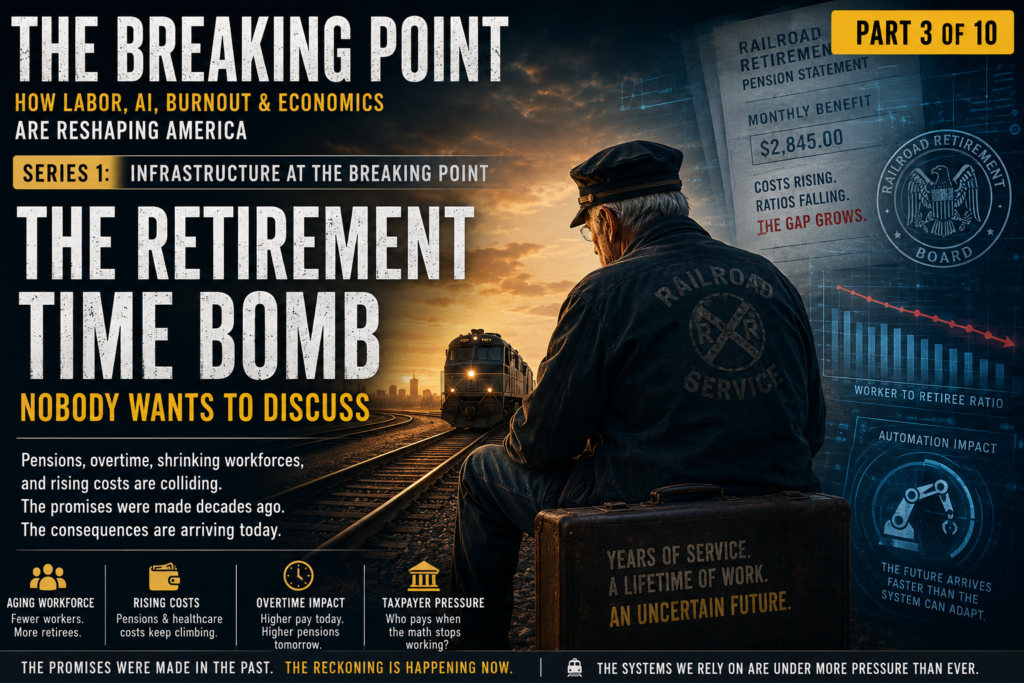
In Part 1, we explored how the Long Island Rail Road strike exposed deeper operational pressure building beneath America’s infrastructure systems.
In Part 2, we examined how overtime quietly evolved from an occasional necessity into a permanent operating model across many critical industries.
Now the conversation moves into one of the most difficult and emotionally charged issues of all:
Retirement sustainability.
Because underneath many of America’s labor disputes lies a question few politicians, unions, corporations, or taxpayers truly want to confront:
What happens when the long-term math stops working?
Most Americans still think retirement works the way it did decades ago.
You work hard.
You retire.
You collect a pension.
You enjoy your golden years.
But underneath many of America’s largest systems, a quiet financial pressure has been building for decades.
And eventually, someone has to pay for it.
The uncomfortable truth is that America is approaching a collision between:
- retirement obligations
- shrinking labor participation
- overtime dependency
- taxpayer fatigue
- longer life expectancy
- and growing operational instability
This conversation is emotional for a reason.
Because retirement is not just economics.
It is trust.
Workers trusted the promises made to them.
Taxpayers trusted the systems would remain sustainable.
And now many industries are discovering those promises are becoming harder to maintain long term.
Railroad Retirement Is Different
Most Americans do not realize railroad workers operate under a completely different retirement structure than traditional Social Security.
The railroad industry has its own federal retirement system through the:
U.S. Railroad Retirement Board
Historically, railroad jobs were considered:
- dangerous
- physically demanding
- nationally critical
So workers fought for stronger retirement protections decades ago.
And for many railroad employees, those retirement structures became extremely valuable.
Many long-term railroad workers receive:
- pension-style retirement income
- healthcare benefits
- survivor benefits
- earlier retirement eligibility than many private-sector workers
For workers who spent decades:
- working nights
- holidays
- extreme weather
- high-stress schedules
…the argument for strong retirement systems makes sense emotionally and historically.
But that is only one side of the equation.
The Ratio Problem
The real issue facing many retirement systems today is simple math.
These systems work best when:
- large numbers of active workers contribute
- fewer retirees collect benefits
But many industries are now experiencing:
- aging workforces
- declining recruitment
- earlier retirements
- labor shortages
- lower worker-to-retiree ratios
That creates enormous financial pressure.
Especially in industries already struggling with:
- overtime costs
- staffing shortages
- operational inefficiency
At some point the question becomes:
“How many active workers are supporting each retiree?”
And in many systems, that ratio is moving in the wrong direction.
Overtime Quietly Changes Retirement Costs
One issue many taxpayers never fully see is how overtime can affect retirement obligations.
In some systems:
- pensions are based on highest earning years
- overtime dramatically increases compensation totals
- retirement payouts rise accordingly
The Long Island Rail Road has faced repeated scrutiny over overtime structures.
Recent reports showed:
- more than 325 employees earned over $100,000 in overtime alone
- 11 workers exceeded $200,000 in overtime pay alone
For some employees, overtime becomes:
- 40%
- 50%
- or more of total annual compensation
Once overtime becomes embedded in compensation, retirement obligations can grow far beyond original expectations.
That is one reason overtime is not simply a payroll issue.
It becomes a long-term retirement issue as well.
The Public and Private Divide
One reason this topic becomes politically explosive is because retirement security has largely disappeared for much of the private sector.
Millions of Americans no longer receive:
- pensions
- guaranteed retirement income
- retiree healthcare
Instead they rely heavily on:
- 401(k)s
- investment accounts
- Social Security
- personal savings
Meanwhile many public-sector and infrastructure workers still maintain stronger retirement structures.
That creates growing tension.
Especially when taxpayers struggling with their own retirement uncertainty help support systems perceived as more generous.
This is not necessarily about resentment.
It is about sustainability and fairness colliding emotionally.
The Detroit Warning
America has already seen what happens when retirement obligations outgrow operational reality.
The auto industry became a warning sign.
Companies like:
- General Motors
- Ford Motor Company
- Chrysler
…spent decades carrying enormous:
- pension obligations
- retiree healthcare costs
- legacy labor expenses
Eventually those costs became extremely difficult to sustain against:
- global competition
- automation
- shrinking market share
At one point, estimates suggested healthcare and retirement obligations added well over $1,000 to the cost of some vehicles.
The market eventually forced restructuring.
Public systems operate differently because taxpayers and governments often absorb pressure longer than markets do.
But delayed pressure is not eliminated pressure.
Burnout Makes the Problem Worse
Burnout adds another layer to the retirement issue.
Many experienced workers are:
- mentally exhausted
- physically exhausted
- emotionally burned out
That can accelerate:
- early retirements
- workforce exits
- staffing shortages
Which then creates even more overtime pressure on the remaining workforce.
The cycle begins feeding itself.
And eventually systems become dependent on a shrinking number of experienced employees carrying increasingly unsustainable workloads.
That is not a stable long-term model.
The Conversation Nobody Wants to Have
Most discussions around retirement become emotional very quickly.
Workers feel:
“We earned these benefits.”
Taxpayers feel:
“Can the system continue paying for them?”
Management feels:
“How do we keep operations functioning?”
Politicians often avoid confronting the issue directly because nearly every solution carries political risk.
But eventually the math still arrives.
And that may be the deeper warning hidden underneath many of today’s labor disputes.
Final Thoughts
The retirement issue facing America is not simply about pensions.
It is about sustainability.
It is about what happens when:
- aging systems
- labor shortages
- overtime dependency
- longer life expectancy
- burnout
- taxpayer pressure
- and operational instability
…all begin colliding at the same time.
Workers are not wrong for wanting security.
Taxpayers are not wrong for asking difficult financial questions.
And organizations are not wrong for searching for long-term operational stability.
But one thing is becoming increasingly difficult to ignore:
The future of retirement may depend less on what was promised decades ago…
and more on whether the systems supporting those promises can continue surviving in the decades ahead.
Coming Next in The Breaking Point
Part 4 of 10
Why Public Systems Can Hide Bad Math Longer Than Private Companies
We’ll examine:
- subsidies
- taxpayer backstops
- debt
- political incentives
- and why public systems can often delay operational reality far longer than private businesses can.
The question is:
does delaying the pressure actually make the final reckoning worse?
Hashtags:
#RetirementCrisis #PublicPensions #RailroadRetirement #FutureOfWork #Burnout #Infrastructure #Automation #Labor #EconomicReality #Leadership #PublicTransit #Overtime #Workforce #TheBreakingPoint #OperationalSustainability