

THE BREAKING POINT
Series Two — The Automation Economy
What Happens When the Math Stops Working
Part 4 of 8
The New Divide May Be Between Scalable and Non-Scalable Humans
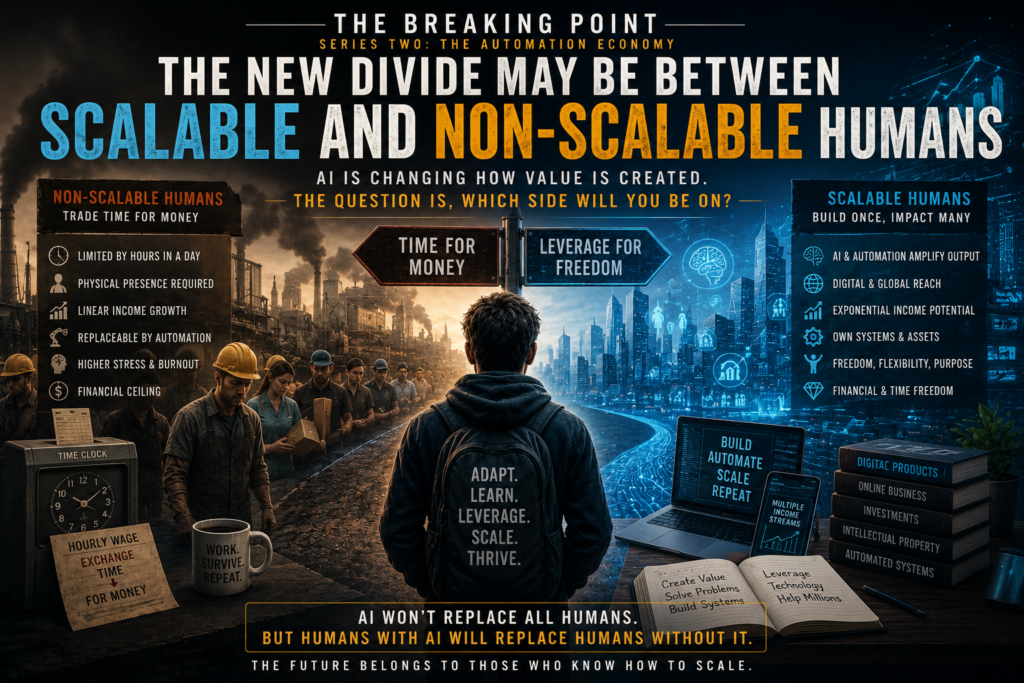
The New Divide May Be Between Scalable and Non-Scalable Humans
For generations, most people understood work through a fairly simple equation:
You traded time for money.
The harder you worked, the more hours you gave, and the longer you stayed committed, the more financially stable life was supposed to become over time.
That model built much of the modern middle class.
Factories ran on it.
Retail operated on it.
Transportation systems depended on it.
Entire industries were designed around the assumption that labor scaled primarily through human hours.
But artificial intelligence, automation, and digital systems may now be changing something much deeper than individual jobs.
They may be changing how human value itself scales inside the economy.
And that shift could quietly create one of the biggest economic divides of the modern era.
The Economy Is Rewarding Leverage Differently
One of the defining characteristics of the digital economy is that some forms of work now scale exponentially while others remain tied almost entirely to time.
A person working hourly inside a physical system can only increase output so far within a 24-hour day.
But digital systems scale differently.
A software creator can distribute products globally almost instantly.
A content creator can reach millions of people simultaneously.
A small business owner can automate operations once requiring large staffs.
An educator can teach thousands online instead of dozens in a classroom.
AI now accelerates that scalability even further.
That changes the relationship between labor, productivity, and income in ways many traditional systems were never designed to absorb.
Some Workers Will Become Massively Amplified
Artificial intelligence does not affect all workers equally.
That may become one of the most important realities of the next economy.
For some people, AI becomes an amplifier.
A highly skilled designer may suddenly produce the output of an entire creative team.
A programmer may automate repetitive coding work that once required multiple employees.
A marketer may scale campaigns globally with AI-assisted analytics and content systems.
A small business owner may operate with the efficiency of a much larger company.
In those environments, technology increases human leverage dramatically.
The worker does not disappear.
But their scalability changes.
And scalability increasingly matters in the modern economy.
Other Work Remains Tied to Time
At the same time, many forms of labor still depend heavily on physical presence and fixed hours.
Healthcare workers must physically care for patients.
Electricians still travel job to job.
Truck drivers remain tied to transportation time.
Many service roles still require direct human interaction.
Those jobs absolutely matter.
Society cannot function without them.
But economically, they scale differently than digital systems.
That difference may become increasingly important as AI expands productivity gaps between scalable and non-scalable work.
This Is Not About Human Worth
One distinction matters enormously.
Scalable work is not morally superior work.
A nurse may contribute far more to society emotionally than a viral influencer ever will.
A teacher may shape lives more profoundly than many highly compensated digital entrepreneurs.
Human value and market value are not always the same thing.
But economies often reward scalability more aggressively than social importance.
And artificial intelligence may intensify that imbalance dramatically.
That creates difficult questions society has not fully answered yet.
AI Is Lowering the Cost of Scale
Historically, scaling businesses required:
- large staffs
- expensive infrastructure
- significant capital
- physical expansion
AI is beginning to lower many of those barriers.
A single highly capable person can increasingly use:
- automation
- AI-generated systems
- digital marketing
- software tools
- algorithmic distribution
to create output that once required entire organizations.
That creates enormous opportunity.
But it also creates disruption for labor systems built around traditional workforce expansion.
Because if fewer people can generate larger amounts of value, the relationship between labor and economic participation begins changing fundamentally.
The Workforce May Split Into Different Economies
One possibility emerging is that society slowly divides into multiple economic layers.
Not necessarily rich versus poor in the traditional sense.
But scalable versus non-scalable.
Some workers may increasingly operate inside highly leveraged digital ecosystems where:
- technology multiplies output
- intellectual property compounds
- AI enhances productivity
- and income becomes less directly tied to hours worked
Meanwhile others may remain inside systems where:
- labor remains time-dependent
- scalability stays limited
- and economic pressure continues rising as automation improves elsewhere
That divide could reshape:
- wages
- education
- taxation
- workforce expectations
- and social stability itself.
Education May Be Preparing Students for the Wrong Economy
This transition raises uncomfortable questions about education.
Many schools still heavily emphasize:
- memorization
- standardized structure
- compliance-based learning
- industrial-era scheduling
Meanwhile the future economy may increasingly reward:
- adaptability
- creativity
- communication
- technological fluency
- entrepreneurial thinking
- scalable problem solving
Artificial intelligence may accelerate this disconnect rapidly.
Because when information itself becomes instantly accessible, the ability to think, adapt, build, and create may become more valuable than simply memorizing static information.
That does not make teachers unimportant.
It may make exceptional educators even more important.
Especially those capable of inspiring curiosity, adaptability, and independent thinking.
The Real Risk Is Social Instability
The deeper danger may not simply be economic inequality.
It may be psychological instability.
Because when large groups of people begin feeling:
- economically replaceable
- structurally trapped
- unable to scale
- or disconnected from opportunity
frustration naturally grows.
Historically, societies become unstable when large numbers of people feel disconnected from meaningful pathways toward advancement and ownership.
That is why this conversation matters far beyond technology itself.
It touches:
- dignity
- purpose
- mobility
- identity
- and social cohesion.
This Transition May Already Be Happening
One reason this shift feels confusing is because it is unfolding unevenly.
Some people are already living inside highly scalable digital economies.
Others still operate almost entirely inside traditional labor systems.
Meanwhile AI continues accelerating both productivity and disruption simultaneously.
That creates a strange environment where different parts of society increasingly feel like they are operating inside completely different economic realities.
And that gap may widen faster than many institutions are prepared for.
Final Thoughts
The future economy may not divide simply between educated and uneducated, rich and poor, or blue collar and white collar.
Increasingly, the deeper divide may involve scalability itself.
Who can leverage technology to multiply output?
Who remains tied entirely to time?
Who owns systems?
Who depends on systems owned by others?
Artificial intelligence is not creating all of these pressures alone.
But it is accelerating them rapidly.
Because once technology changes how value scales, it also changes how labor, income, opportunity, and economic mobility function underneath society itself.
That may become one of the defining transitions of the AI era.
Not simply whether machines replace humans.
But whether humans learn how to scale alongside the systems now transforming around them.
Coming Next in The Automation Economy
Part 5 of 8
When Labor Stops Scaling, AI Starts Winning
We’ll examine how rising costs, staffing instability, burnout, and operational pressure increasingly push organizations toward automation — not necessarily because they want to replace workers, but because scalability itself is becoming harder to sustain.
Hashtags:
#TheBreakingPoint #AutomationEconomy #ArtificialIntelligence #ScalableIncome #FutureOfWork #AI #EconomicTransition #DigitalEconomy #FutureEconomy #Technology #Workforce #Entrepreneurship #Leadership #Ownership #Innovation