

THE BREAKING POINT
Series Two — The Automation Economy
What Happens When the Math Stops Working
Part 3 of 8
Are We Raising Builders or Consumers?
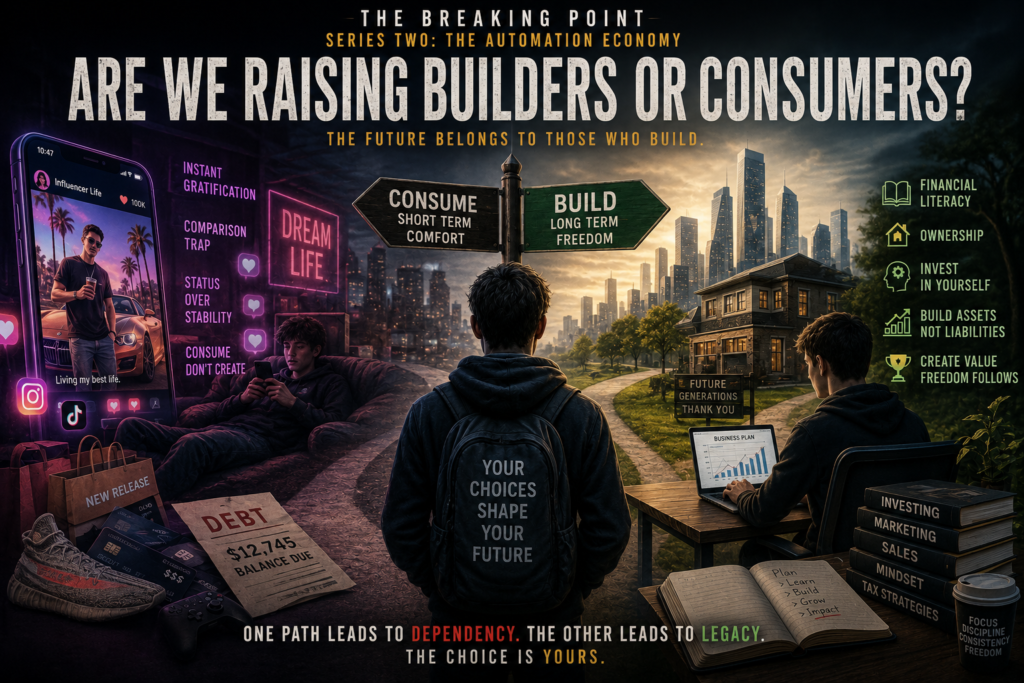
Are We Raising Builders or Consumers?
One of the biggest questions quietly forming underneath the modern economy may have nothing to do with artificial intelligence itself.
It may involve how younger generations are being prepared to think about work, ownership, money, and long-term stability.
Because for decades, America benefited from a culture that strongly encouraged people to:
- build businesses
- buy homes
- invest
- develop skills
- create equity
- and slowly accumulate assets over time
Ownership mattered.
Building mattered.
Patience mattered.
But the environment surrounding younger generations today looks dramatically different than the world previous generations entered.
And whether people realize it or not, culture itself may now be influencing economic behavior as much as policy ever did.
Social Media Changed How Success Looks
For most of modern history, financial success usually appeared gradual.
People associated wealth with:
- careers
- businesses
- real estate
- investing
- skilled trades
- entrepreneurship
- long-term discipline
Today, social media compresses perception.
Younger generations now grow up watching:
- influencers
- YouTubers
- streamers
- online personalities
- viral entrepreneurs
Many appear to achieve financial success rapidly, publicly, and at massive scale.
That changes how success feels psychologically.
Traditional wealth-building often looks slow and invisible compared to viral visibility.
The danger is not that digital opportunity exists.
The danger is when visibility starts replacing understanding.
Because what people see online is often the outcome — not the years of risk, failure, inconsistency, or luck underneath it.
The Internet Created Real Opportunity — And Unrealistic Expectations
To be fair, the digital economy has absolutely created legitimate opportunity.
Some people genuinely are building:
- scalable businesses
- valuable media brands
- online education platforms
- software companies
- content businesses
- digital consulting operations
That opportunity is real.
But social media also distorts probability.
Millions of young people now consume content suggesting:
- traditional careers are pointless
- instant success is normal
- fame equals wealth
- ownership requires little sacrifice
- and financial stability can be achieved quickly without long-term planning
That creates a dangerous imbalance between aspiration and preparation.
Especially when financial literacy itself often remains weak.
Financial Literacy Is Quietly Disappearing
One of the strangest contradictions in modern society is that people have more access to information than at any point in history…
while simultaneously struggling with basic financial understanding.
Many young adults enter adulthood without deeply understanding:
- investing
- compound growth
- debt
- taxes
- credit
- homeownership
- retirement planning
- risk management
Instead, much of modern financial culture increasingly revolves around:
- consumption
- appearance
- lifestyle signaling
- short-term gratification
- digital status
That may become one of the biggest long-term vulnerabilities in the future economy.
Because societies built primarily around consumption eventually depend heavily on someone else continuing to build, invest, maintain, and create.
Ownership Changes Everything
One reason previous generations often focused so heavily on ownership is because ownership scales differently than labor alone.
A person working hourly can increase income only so far through time.
But ownership allows people to build:
- equity
- appreciation
- cash flow
- leverage
- long-term stability
That can come through:
- businesses
- investments
- intellectual property
- real estate
- scalable systems
The modern economy increasingly rewards scalability.
And that may become even more true in the AI era.
Because artificial intelligence allows:
- small teams to scale faster
- digital products to reach larger audiences
- individuals to operate more efficiently
- intellectual property to compound more rapidly
In many ways, AI may widen the gap between scalable ownership and purely time-based labor even further.
Dependency Systems Create Different Incentives
Another uncomfortable conversation involves dependency itself.
When people begin believing:
- ownership is unattainable
- upward mobility feels impossible
- long-term stability feels unrealistic
they often shift psychologically toward survival behavior instead of building behavior.
That can lead people to prioritize:
- immediate relief
- short-term consumption
- dependency systems
- emotional escape
- low-risk decision making
Over time, entire cultures can slowly begin drifting away from long-term wealth-building thinking.
Not necessarily because people are lazy.
But because the environment surrounding them no longer feels predictable enough to justify delayed gratification.
That distinction matters enormously.
The Housing Divide Is Changing Generational Thinking
Housing may be one of the biggest psychological drivers behind this transition.
For previous generations, homeownership often represented:
- stability
- equity
- independence
- long-term investment
- family security
But many younger Americans increasingly view homeownership as:
- unattainable
- delayed
- risky
- or permanently out of reach
That changes behavior dramatically.
Because once people stop believing ownership is realistically achievable, the motivation to build long-term financial foundations often weakens as well.
And that shift may quietly reshape economic culture itself over time.
AI Will Reward Builders Even More
Artificial intelligence may dramatically increase the importance of:
- adaptability
- creativity
- ownership
- scalable thinking
- intellectual leverage
Because AI allows highly productive individuals and small teams to accomplish things that previously required much larger organizations.
That creates enormous opportunity.
But it also creates risk.
The future economy may increasingly reward people capable of:
- building systems
- leveraging technology
- creating scalable value
- adapting continuously
while placing greater pressure on purely repetitive labor structures.
That transition may already be beginning.
This Is Not About Blaming Young People
One important distinction matters here.
This conversation should not become:
“Young people are lazy.”
That misses the larger reality entirely.
Younger generations inherited:
- higher housing costs
- weaker retirement systems
- rising debt
- digital distraction
- unstable economic expectations
- rapid technological disruption
- and a culture increasingly centered around visibility and consumption
Those conditions shape behavior.
At the same time, many younger people are incredibly creative, adaptive, entrepreneurial, and technologically capable in ways previous generations never had to be.
The challenge is whether society is preparing them to build long-term stability…
or simply teaching them how to consume the systems around them.
Final Thoughts
The future economy may increasingly divide into two groups:
People who build scalable value.
And people who remain dependent on systems built by others.
That does not mean everyone must become an entrepreneur or influencer.
But it does mean financial literacy, ownership, adaptability, and long-term thinking may become more important than ever before.
Because artificial intelligence is not simply changing jobs.
It may be changing how value itself gets created.
And societies that lose the culture of building eventually struggle maintaining the systems they depend on long term.
That may become one of the defining economic and cultural questions of the AI era:
Are we preparing future generations to build…
or simply teaching them how to consume?
Coming Next in The Automation Economy
Part 4 of 8
The New Divide May Be Between Scalable and Non-Scalable Humans
We’ll examine how AI, automation, and digital leverage may reshape the future workforce into those who can scale their skills and output — and those whose labor remains tied strictly to time.
Hashtags:
#TheBreakingPoint #FinancialLiteracy #AutomationEconomy #ArtificialIntelligence #FutureEconomy #Ownership #WealthBuilding #AI #FutureOfWork #EconomicTransition #ScalableIncome #Leadership #Entrepreneurship #Investing #Workforce